Works, experiments and research notes
In Ran, does light reveal a reality that is already present,
or does it participate in producing it?

A Grammar Born Through the Works and Open to Several Universes
Ran was not born from a theory or from a predetermined set of rules. The works came first. Through their making, repetition and observation, certain regularities appeared, received names and gradually became stabilised.
These rules have a history. This history is neither cumulative nor directed towards a definitive form of Ran. A new rule does not necessarily destroy the previous ones, nor is it always simply added to them. It may extend, transform or suspend them, or open a different universe.
The following texts therefore describe a grammar in the making: the present state of a research born from what the works themselves have brought to light.
works → recognised rules → stabilisation / transformation / suspension / new universe
Ran1 does not become false when overlap is stabilised in Ran2. Ran7 does not cancel Ran3. Ran9 and Ran11 develop two different conceptions of volume without either replacing the other.
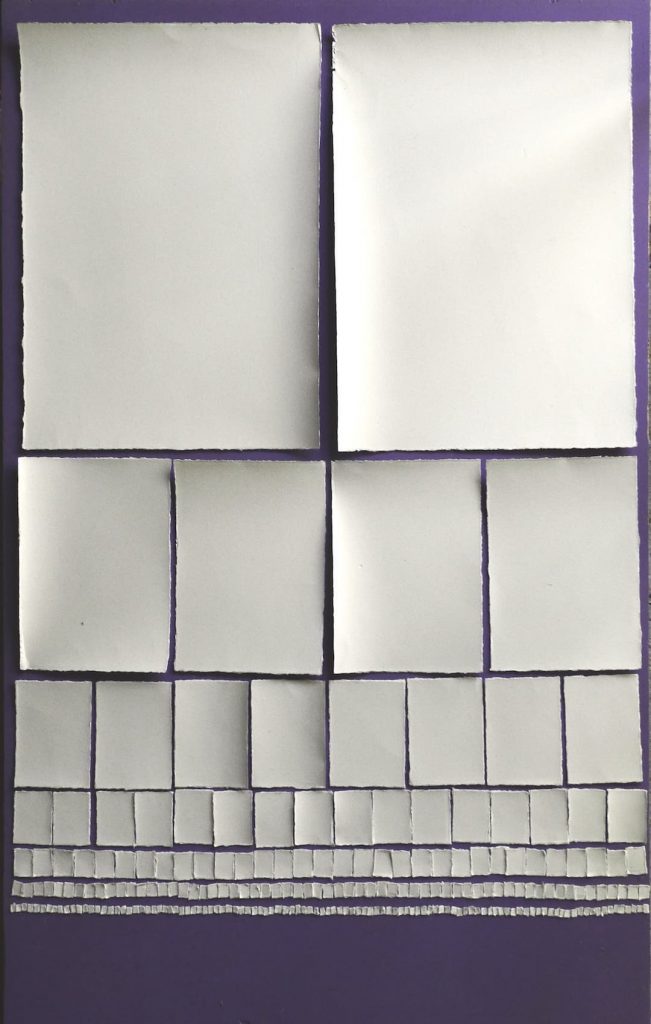

Within the grammar that becomes stabilised from Ran3 onwards, the material history of every individual begins with a sheet.
At the beginning of this genealogy, the sheet is One. It forms a continuous surface, materially bounded by its edges. It is both matter and abstraction: it can be considered as a whole, as a body, but also as the number 1 destined to become a population.
Before entering Ran, the sheet already possesses a particular constitution:
It therefore carries a history that precedes the individuals that will emerge from it.
Folding and tearing are the first acts of its transformation.
The fold alters, compresses and weakens the material. Tearing separates it irreversibly. Yet this division does not merely produce fragments. It brings forth new bodies, still born from the same whole but now capable of receiving their own singular histories.
As long as division is meant to continue, each part may still be considered as another sheet:
F → F1 + F2 + F3 + F4
This notation does not mean that the four sheets are identical. It only indicates that they temporarily retain the same status within the process of division.
When the division of a fragment stops, its status changes. It becomes a body intended to receive an individual history:
Fx
The index x acts here as a provisional first name. It distinguishes this singular body before it passes through the press and before it enters the relations of Ran.
From Ran3 onwards, the divisions are homothetic: each new body preserves the proportions of the sheet from which it comes.
If the initial sheet possesses a certain relationship between height and width, this relationship remains present in its descendants:
h(F) / w(F) = h(Fx) / w(Fx)
This does not mean that their dimensions are identical. The bodies may be large, medium or small while preserving the same proportions:
L M S
This regularity was not initially chosen as a mathematical principle. It arose from a practical, aesthetic and bodily decision: folding and tearing rather than measuring, drawing and cutting.
Folding made it possible:
Only afterwards did the mathematical consequences of this method become visible.
The gesture was not produced by the mathematical rule. The gesture produced a regularity that mathematics later made it possible to recognise.
The initial sheet does not entirely disappear when it is divided. Its first unity persists as a shared material origin.
Some bodies retain an outer edge of the original sheet. Others possess only edges born through tearing. A few still carry one of its four corners.
At every complete generation of division, four descendants retain the trace of an original corner:
Noriginal corners = 4
The population therefore shares a common history without all its members carrying the same marks.
same origin ≠ same marks
Division simultaneously produces:
a shared origin + singular histories
Here, the + sign does not add quantities. It expresses the coexistence of two realities born from the same gesture.
The sheet is therefore neither a passive support waiting to receive an image nor a material erased by division. It remains an anterior whole, a material memory and a promise of multiplicity.
The individual separates from the sheet, but the sheet continues to exist within the constitution of the individual.
Dividing the sheet brings number into Ran.
At the beginning, the sheet may be considered as a whole:
1F
After one complete generation of folding and tearing, it produces four bodies. At the following generation, each of these may be divided in turn:
1 → 4 → 16 → 64 → 256 → 1024 → 4096 → …
At each generation g, the number of bodies produced is:
Ng = 4g
| Generation g | Number of bodies Ng |
|---|---|
| 0 | 1 |
| 1 | 4 |
| 2 | 16 |
| 3 | 64 |
| 4 | 256 |
| 5 | 1024 |
| 6 | 4096 |
The number 4096 holds a particular place in my work. It corresponds to the sixth complete generation of division, but also to the 4096 colours of the Amiga 500. It could therefore become the arbiter of the population of Ran7.3 without determining what that population would become.
The number decides upon a population; it does not decide the work.
The One sheet does not produce bodies by adding matter. It distributes its own matter among a growing population.
1F — division → 4gFx
Each body then receives its singular history:
4gFx — press → 4gix
Finally, entering into relations transforms this population of bodies into a population of individuals:
4gix — relations → R
The 1 is not simply replaced by number. It remains within that number as a shared material origin.
the One → the many
the many → a new form of the One
In the ideal model, division neither creates nor destroys any surface area.
Let S0 be the area of the initial sheet. At generation g, the area of each body is:
sg = S0 / 4g
Yet their number is:
Ng = 4g
The total area of the population therefore remains:
Ngsg = S0
| Generation | Bodies | Area of each body | Population area |
|---|---|---|---|
| 0 | 1 | S0 | S0 |
| 1 | 4 | S0/4 | S0 |
| 2 | 16 | S0/16 | S0 |
| 3 | 64 | S0/64 | S0 |
| 6 | 4096 | S0/4096 | S0 |
The population grows while the area of each body diminishes. Yet the area of the whole does not change.
growing population + diminishing bodies = conserved surface
Here, the + sign does not represent a numerical addition. It connects three simultaneous phenomena.
The sheet becomes number without ceasing to be the common surface of that number.
The total surface remains, but boundaries multiply.
At every generation, the height and width of each body are divided by two. If P0 is the perimeter of the initial sheet, the perimeter of each descendant becomes:
pg = P0 / 2g
Since the population now contains 4g bodies, the sum of their perimeters is:
Pgtotal = 4g × P0 / 2g
therefore:
Pgtotal = 2gP0
| Generation | Perimeter of each body | Sum of perimeters |
|---|---|---|
| 0 | P0 | P0 |
| 1 | P0/2 | 2P0 |
| 2 | P0/4 | 4P0 |
| 3 | P0/8 | 8P0 |
| 6 | P0/64 | 64P0 |
This calculation adds together the perimeters of all the separated bodies. If the sheet were reconstructed exactly, its outer contour would remain P0. Yet its new internal boundaries would still exist, since every separation has produced two edges facing one another.
constant surface ; growing boundaries
Dividing does not create more surface. Dividing produces more edges.
Each edge then becomes a possibility:
division → multiplication of bodies → multiplication of boundaries → possibilities of relation
The relations have not yet been realised, but the conditions for their appearance are multiplying.
All the bodies come from the same sheet, but they do not retain the same visible signs of it.
Some possess only edges produced by tearing. Others retain an edge belonging to the initial sheet. At every complete generation, four bodies still carry one of its original corners:
Noriginal corners = 4
The memory of the One is therefore shared, but its traces are distributed unevenly.
same origin ≠ same marks
The bodies share a material inheritance without becoming interchangeable.
As generations succeed one another, the population grows:
Ng → +∞
At the same time, the area of each body diminishes:
sg → 0
Yet no finite generation truly produces infinity or nothingness. At every generation actually reached:
Ng < +∞ and sg > 0
The population remains finite and countable. Each body retains an area, however small it may be. The two movements nevertheless remain linked:
Ngsg = S0
The number increases.
The individual diminishes.
The surface of the One remains.
The individual tends towards almost nothing, the population towards the innumerable, while the surface of the One remains between them.
These values do not meet. They answer one another while moving towards two limits that the physical gesture can never reach.
almost nothing ↔ the surface of the One ↔ the almost innumerable
These numbers do not serve to predict a work or dictate its form. They make it possible to look differently at what the gesture has already produced.
Manual division brings forth:
Through numbers, reality described and reduced constructs a poetic imagination.
Calculation does not dispel the mystery of the divided sheet. It gives that mystery another space in which to unfold.
In Ran, being an individual does not mean being separate. It means entering into relation.
This reversal produces an apparent paradox. In ordinary language, an individual is often understood as something that distinguishes and isolates itself. In Ran, on the contrary, it is relation that individualises.
Three successive states can be distinguished:
Fx → ix → i
| State | Situation | What characterises it |
|---|---|---|
| Fx | Before the press | A body born from the sheet and carrying inherited matter |
| ix | After the press, still isolated | A singular body that has received a personal history |
| i | After entering into relation | An individual participating in the solidarity of Ran |
This succession is not merely a material transformation. It produces two changes of status.
Fx designates a body produced through the division of the sheet, before it passes through the press.
It already possesses a particular constitution:
Its personal history has not yet begun, but its future is not entirely free. The matter it inherits already conditions what may happen to it.
inherited matter → possibilities of transformation
Two bodies produced from the same sheet may receive the same matrix, pigments and pressure without becoming materially identical.
Matter is not a passive support. It participates in the action it receives.
Passing through the press constitutes an event.
Pressure, matrices, pigments, water, reserves, embossing, accidents and repeated passages enter the body of the paper.
Fx — press → ix
The body does not merely carry the traces of the action: it has been transformed by it.
action received → acquired matter
It then becomes ix: a singular and recognisable body, prepared for a possible gathering but still considered in isolation.
The index x acts as a provisional first name. It distinguishes this body from the others and recalls that it possesses a personal and unique history.
In isolation, ix is not yet an individual of Ran. It is a singular body awaiting relation — a kind of orphan.
The history of ix is not simply added to its initial matter. It transforms that matter and becomes one of the conditions of what may follow.
inherited matter → action → acquired matter → the next action
Inherited matter conditions the action.
The action becomes acquired matter.
Acquired matter conditions the next action.
History enters the body and becomes one of the conditions of its future.
The constitution of the paper partly determines how pigments penetrate, settle or mix. After several passages, however, the first layers of its history in turn condition the way later layers are fixed.
Original embossing, reserves and early imprints may continue to appear beneath subsequent transformations. They may become less visible without ever being completely erased.
The body therefore acquires a temporal depth:
present body = inherited matter + acquired histories
Here, the + sign calculates no quantity. It expresses the coexistence of several times within the same matter.
This transformation cannot be repeated indefinitely without consequence.
Through repeated passages under the press, the paper may be crushed, stabilised or deprived of some of its possibilities of deformation. Layers of colour may eventually cover earlier accidents, darken the matter or make uniform what was once differentiated.
repetition → accumulation → possible saturation
Exhaustion simultaneously concerns:
Exhaustion does not necessarily mean that every possibility has disappeared. It may become a new state of the matter, conditioning the next action differently.
ix becomes i when it enters into relation with other singular bodies.
ix — entering into relation → i
This passage does not always require a new internal transformation. The material body may remain the same while its status changes.
same body + new relation → new status
From that moment onwards, it is no longer named by its first name x alone. It receives the same designation as the other individuals because it now participates in a larger solidarity.
i1, i2, i3, …, in → R
This shared designation does not erase its material singularity. It only means that its relational role becomes primary within the description of Ran.
The first name disappears from the notation, but its history does not disappear from the body.
singularity of the body ≠ isolation
shared designation ≠ uniformity
All individuals are named i, yet none is materially identical to another.
The gathering of several individuals does not merely produce an addition:
i1 + i2 + i3 + … + in
It brings forth something new that belongs to none of the individuals taken separately:
population + relations → Ran
Once again, the + sign does not represent an abstract addition. It expresses the encounter between a population and the relations that organise it.
Ran is the third thing produced by that encounter.
The movement is reciprocal:
i → R → i → R → …
In isolation, it is a singular body. In relation, it becomes an individual.
This definition can extend beyond the monotype alone. What matters is that a body has received a history strong enough to become singular, and that a change in relation gives it a new status within a Whole offered to experience.
An accumulation of singular bodies is not sufficient to produce a Ran.
The individuals must enter an organisation in which their relations themselves become active. These relations determine their positions, statuses and neighbourhoods, and the way a Whole may appear.
population + relations → Ran
This formula does not add two quantities. It indicates that Ran appears through the encounter between a population and the way that population is organised.
A Ran appears when a population of singular bodies, carrying a history of transformations, changes status by entering relations that become the active principle of the work and bring forth a Whole offered to experience.
A relation between two individuals may provisionally be written:
ℛ(ij, ik)
This formula calculates nothing. It simply indicates that the individual ij is in relation with the individual ik.
The indices j and k distinguish the individuals within the description. They are neither first names nor material properties.
If a relation must preserve a particular rule, we may write:
ℛ(ij, ik) = λ
The symbol λ designates what must be maintained between the two individuals:
The formula therefore means:
The relation between ij and ik must preserve a property defined by λ.
If one individual moves while their relation must remain constant, the other may be required to move in turn:
Δij → Δℛ → Δik
The modification may then be transmitted to the rest of the population:
local movement → relational transmission → reorganisation of the Whole
In Ran1, this transmission is materially produced by staples. In other Ran, it may depend on an assembly rule or a protocol of reorganisation.
Overlap is one of the most frequent relations in Ran, but it should not be used as the name for every relation.
| Form of relation | What connects the individuals |
|---|---|
| Overlap | One individual partially covers another |
| Contact | Two edges or surfaces touch |
| Material connection | A staple, nail, magnet or another body holds them together |
| Maintained distance | A defined space separates two individuals or two rows |
| Alignment | Several individuals produce a row, column or perceptible direction |
| Luminous relation | The light or shadow received by one individual depends on the position of another |
| Neighbourhood relation | Two individuals occupy nearby coordinates without necessarily touching |
overlap ⊂ the relations of Ran
Overlap belongs to the possible relations of Ran, but not every relation is an overlap.
In Ran1, the relation is produced by staples. It is therefore more than an abstract organisation.
ij ← staple → ik
A staple possesses:
The relation therefore possesses its own body.
The link does not merely exist between two bodies: it becomes a third body acting upon them.
An interior individual in Ran1 has four direct neighbours:
Nneighbours(i) = 4
Yet each side has two staples. It therefore possesses eight material connections:
Nconnections(i) = 8
| Neighbourhood relation | Number |
|---|---|
| Neighbouring individuals | 4 |
| Connections per neighbour | 2 |
| Total connections | 8 |
| Direct diagonal relations | 0 |
one neighbour ≠ one connection
Two individuals may be neighbours while being connected more than once.
From Ran2 onwards, overlap becomes a recurrent and oriented relation.
If ij+1 partially overlaps ij, we may write:
ij ≺ ij+1
The symbol ≺ means here that ij precedes ij+1 in the order of placement.
Overlap simultaneously produces:
order of placement → order of overlap → time made visible
What lies underneath was placed before.
What lies above was placed afterwards.
Overlap inscribes the succession of gestures within space.
This temporality does not belong to every relation in the same way. The reciprocal mesh of Ran1 certainly has a time of fabrication, but its completed organisation does not necessarily reveal who precedes and who follows.
Ran1: ij ↔ ik
Ran2 and later works: ij → ij+1
The first relation emphasises reciprocity and transmission. The second makes an orientation and a succession perceptible.
If i1 is directly connected to i2, and i2 is directly connected to i3, then i1 and i3 belong to the same network.
ℛ(i1, i2) and ℛ(i2, i3)
i1 → i2 → i3
This does not necessarily mean that i1 and i3 share a direct relation. We may write:
i1 ⇢ i3
The arrow means here that i1 is indirectly connected to i3 through i2.
belonging to the same network ≠ being direct neighbours
An individual may therefore act indirectly upon another without touching or overlapping it.
In a simple linear row, each new individual overlaps only the one immediately preceding it.
i1 → i2 → i3 → … → in
| Individuals Ni | Overlaps T |
|---|---|
| 1 | 0 |
| 2 | 1 |
| 3 | 2 |
| 4 | 3 |
| 5 | 4 |
| n | n − 1 |
T = Ni − 1
A simple linear row always requires one overlap fewer than its number of individuals.
This −1 produced the first mathematical vertigo of Ran.
It is not, however, a universal law governing all its relations. It remains true when every new individual creates exactly one relation with the individual immediately preceding it.
If additional relations appear, if several rows cross or if a loop is formed, the number of relations may become equal to or greater than the number of individuals.
T = Ni − 1
therefore describes one first family of Ran rather than the whole system.
Discovering a rule does not complete the research: it makes it possible to seek the situations in which that rule ceases to be true.
Individuals may be located through rows, noted a, and columns, noted b.
Each meeting between a row and a column defines a unique coordinate:
ia,b
For example, i3,5 designates the individual located in the third row and fifth column.
| Symbol | Designation |
|---|---|
| a | A row |
| b | A column |
| A | The total number of rows |
| B | The total number of columns |
| ia,b | The individual situated at their meeting |
This grid describes the distribution of a population without asserting that its material form is regular.
If the number of rows equals the number of columns:
A = B
the distribution is mathematically square. This does not mean that the visible Ran forms a geometrical square.
square distribution ≠ square plastic form
The proportions of the individuals, their overlaps, inclinations, depths and intervals transform the form that is actually perceived.
In some Ran, rows and columns may both be materially constituted. In Ran7, their statuses differ.
The rows a are assembled and possess a material body:
a = constructed structure
The columns b possess no autonomous material connection. They result from the relative alignment of individuals belonging to several rows:
b = spatial or perceptual relation
When the rows are close, a vertical relation may be materially or visually perceptible. As they move apart and gradually rise, the column may lose its continuity:
material b → relational b → perceived b
The column may persist as a coordinate or an alignment, then disappear according to the position of the gaze.
The intervals separating individuals or rows are not necessarily absences.
In Ran7, discrete spaces participate in the structure. They allow:
individuals + relations + the spaces between them → the space of Ran
In Ran, the space between individuals is not necessarily what separates them. It may be precisely what places them in relation.
Ran is therefore not merely composed of individuals. It appears in what occurs between them.
In the Ran organised through oriented overlap, origin O and ultimate U are not necessarily permanent properties of a body.
They designate statuses produced by:
material body + relational position → status
The same body may therefore be an origin in one incarnation, an intermediate individual in another, and an ultimate in a third.
ix → O / i / U
Origin and ultimate do not merely describe what a body is. They describe the place it occupies in relation to others.
Let us imagine the first body after it has passed through the press.
At the first moment of placement, it remains alone:
t1: ix1
It possesses matter, history and singularity, but no relation yet exists.
It is therefore not yet an individual of Ran and cannot be considered as an origin.
Ni = 1 ⇒ O = ∅
Only when a second body enters into relation with it do both statuses appear.
At the second moment:
t2: ℛ(ix1, ix2)
The first body becomes the origin of the relation:
ix1 → O
The second body becomes an individual and, within the current state of the incarnation, its provisional ultimate:
ix2 → U2
The arrival of the second body does not physically transform the first or modify the past. It nevertheless gives its earlier position a meaning that it did not yet possess.
It is not origin that produces the first relation: it is the first relation that produces origin.
A temporal paradox appears:
O is first in the succession, but second in its constitution.
The second individual does not physically return to the past. Its arrival retrospectively transforms the meaning of the first event.
Before the relation, there was a body that had been placed. After the relation, that same body becomes the beginning of a history.
first body — arrival of a second → origin
In isolation, the first body is not yet an origin. It becomes O when the arrival of a second individual makes its earlier position the beginning of a relation.
Ultimate U possesses a different temporality.
In a Ran currently containing n individuals, the last individual placed receives the status:
Un = in
It remains Un for as long as no successor enters into relation with it.
Un — absence of a successor → Un
When a new individual appears:
ℛ(in, in+1)
the former ultimate loses its status:
Un → in
and the new individual becomes:
in+1 → Un+1
The succession may therefore be written:
U2 → U3 → U4 → … → Un
It is not the same body moving through the structure. It is the status of ultimate that passes from one individual to the next.
| Status | How does it appear? | What happens next? |
|---|---|---|
| O | The first body becomes origin when the first relation appears | It generally remains attached to the beginning of the succession |
| Un | The last body currently placed becomes ultimate | It loses this status when a successor appears |
| in | The former ultimate enters the continuity of Ran | It becomes an intermediate individual |
Origin is fixed by the first relation. Ultimate remains mobile for as long as Ran stays open.
U is not merely the last visible individual. It occupies the present boundary between:
accomplished history → Un → possible continuation
It is both the last accomplished event and the point awaiting the next.
Ultimate is less an ending than a position from which Ran may continue.
If no new individual is added, Un may retain its status for a few seconds, several years or indefinitely.
We must therefore distinguish the event that produces its status from the state during which that status persists.
Let En be the event corresponding to the placement and connection of the nth individual:
En = the entry of in into relation
The relational time of Ran may be written:
E1 ≺ E2 ≺ E3 ≺ …
This notation does not measure the duration separating the events. It indicates only their order: before, after, previous and next.
After each event, Ran enters a new state. Let us call it Sn:
Sn = the state of Ran after En
The sequence becomes:
En → Sn → En+1
The event may be considered punctual within the model. The state may persist.
event without measured duration → state of indeterminate duration
Relational time does not measure how much time passes. It records how many relations have appeared and in what order.
Ran therefore possesses at least two forms of time.
| Temporality | What it describes |
|---|---|
| Relational time | The order in which individuals and their relations appear |
| Material time | The drying, ageing, wear and continuous transformation of paper |
Relational time may be noted through successive events:
E1, E2, E3, …
Material time may be noted τ:
τn+1 − τn = Δτn
Between two relational events, the clock of construction may appear to wait. Matter, however, continues to act:
relational time waiting ; material time continuing
Relational time waits; material time continues the work.
In a Ran made of several rows, each row may possess its own origin and ultimate.
Oa,j → i2,a,j → i3,a,j → … → Ua,j
We may therefore have:
Oa1, Oa2, …, OaA
Ua1, Ua2, …, UaA
Each row carries its own temporal succession, even while participating in a larger organisation.
several local histories → one Ran
This notably appears from Ran3 onwards, where different rows possess their own beginnings and endings.
The complete Ran may therefore contain several origins without necessarily possessing a single origin.
According to the presence or absence of O and U, four major cases can be distinguished.
| Structure | Origin | Ultimate | Form |
|---|---|---|---|
| Finite Ran | Yes | Yes | O → U |
| Semi-infinite Ran | Yes | No | O → +∞ |
| Inoriginel Ran | No | Yes | −∞ → U |
| Ran without origin or ultimate | No | No | −∞ → +∞ |
O → i2 → i3 → … → U
It possesses both a beginning and an ending.
O → +∞
It possesses an origin but no structural ultimate. A physical incarnation may nevertheless possess a provisional ultimate:
Un = in
−∞ → U
It possesses an ultimate but no designable origin:
O = ∅
An inoriginel Ran is not a Ran whose origin has been forgotten or lost.
It is a Ran within which no first individual can be designated.
−∞ → +∞
Every individual possesses a predecessor, a successor, an individual that it overlaps and an individual by which it is overlapped.
No individual can permanently receive the status O or U:
O = ∅ ; U = ∅
An individual may be chosen as a reference point:
i0
but:
i0 ≠ O
Zero may give the observer a position without creating a beginning in Ran.
Every material realisation nevertheless possesses a finite population and occupies a bounded space.
It may be understood as the capture of an interval belonging to a larger phenomenon:
… → im−1 → im → … → in → in+1 → …
The framed part corresponds to what the tableau, installation or support makes visible:
Cm,n = { im, …, in }
Inside the capture:
OC = im
UC = in
Within the theoretical phenomenon that exceeds it, however, im may have a predecessor and in may have a successor.
The frame therefore produces simultaneously:
an apparent beginning + an apparent ending
It makes finite what may be thought of as indefinitely extendable.
A physical Ran, such as a Ran-tableau, may therefore be understood as a photograph — or, more precisely, as a spatio-temporal section.
It does not necessarily show the actual birth and ending of the phenomenon. It shows what has been retained between two boundaries.
earlier off-frame space → OC → visible history → UC → possible off-frame continuation
OC becomes the beginning of what the capture allows us to see.
UC becomes its arrested present, the last state retained before a possible continuation.
The tableau makes the two edges of a phenomenon appear as origin and ultimate by interrupting it in order to make it visible.
It then becomes necessary to distinguish three levels.
| Level | Origin and ultimate |
|---|---|
| Structural | The actual beginning and ending of the system, if they exist |
| Operational | The first and last bodies effectively placed during fabrication |
| Visible | The first and last individuals that the frame allows us to perceive |
They may be noted:
Ostructural, Ooperational, Ovisible
Ustructural, Uoperational, Uvisible
These statuses may coincide:
Ostructural = Ooperational = Ovisible
but they do not have to.
The first visible individual may be only the entrance to the capture. The last may be only the present edge of what the tableau retains.
boundary of visibility ≠ limit of the phenomenon
The phenomenon does not necessarily begin when the tableau shows it. It may be thought of as already under way, both before and after it.
What is truly born is its visibility as a bounded form.
phenomenon under way — capture → visible Whole
The capture therefore does more than show a reality. It produces the conditions through which that reality appears to us as:
The phenomenon does not begin inside the tableau. The tableau interrupts it long enough to make it visible.
Colour is matter’s response to light.
A colour is never One. It is neither alone nor unified. Its unity depends only on the distances and orientations of light and gaze. No more, no less—but one has to know it.
It is also, and above all, left to the goodwill of light.
Colour is what our eyes say about light.
These sentences, drawn from earlier notes, already contain the principal agents of this research:
matter ↔ light ↔ gaze
In Ran, light does not simply illuminate an already constituted work. It reveals some of its properties, conceals others, and participates in the particular reality that becomes visible from a given position and at a given moment.
Colour is therefore neither a stable quality of the object nor an appearance produced entirely by the gaze. It emerges from an encounter between matter, light, an environment and an experiencer.
I use the word experiencer here, after the French term expérienceur, which I first encountered through Virginie Tillier. In these pages, it designates the person whose position, attention, memory and sometimes gestures participate in the experience of the work.
This expression does not calculate any colour. The + sign does not add quantities: it expresses the coexistence and encounter of several realities.
Light acts as a revealer, an agent and an intermediary. It enables a relation between matter and gaze without ever being separable from the place through which it passes.
The experiments carried out in Ran7, Ran8 and Ran9 explore different modes of this relation:
| Ran | Action of light | What becomes perceptible |
|---|---|---|
| Ran7 | It moves through relational space | Rows, intervals, depths and shadows |
| Ran8 | It passes through transformed matter | A translucent form that remained latent within the paper |
| Ran9 | It encounters a constructed topography | Levels, reliefs and their apparent animation |
These experiments do not seek to demonstrate a theory of colour. They constitute a body of situated, empirical and artistic observations.
I do not entirely choose a colour: I construct the conditions of its possibility.
A colour is not a collection of names.
“Cherry red”, “anise green”, “midnight blue” or “lemon yellow” make it possible to designate, classify and communicate an approximate colour experience. But these words are not the colour itself.
colour name ≠ perceived colour
A name attempts to stabilise through language what remains variable in experience. Its function is not limited to communication. By placing colour within a recognisable category, it may lead to its confinement, turning it into a desirable and exchangeable object, or into the symbol of something external to itself.
Two surfaces may both be called “red” while presenting very different appearances. Conversely, the same surface may continue to be called “red” even when light, surrounding matter or distance profoundly transform what we see.
The word constructs a shared category. Colour remains a singular appearance.
Hue makes it possible to locate a colour abstractly within a family: red, yellow, green, blue, and so on.
But colour as it is experienced also includes:
| Notion | Function |
|---|---|
| Colour name | To designate and communicate |
| Hue | To locate a chromatic family abstractly |
| Situated colour | To appear within a particular matter, light, space and gaze |
A hue can be isolated abstractly on a colour chart. A lived colour can never be entirely detached from the matter it inhabits—or that inhabits it—from its extent, from the way it responds to light, and from the memories to which its appearance is connected.
Hue can be isolated abstractly. Colour is situated.
Matter may remain provisionally unchanged while its colour appearance is transformed.
M = constant but Cp(t1) ≠ Cp(t2)
In Ran7, the course of the sun, the movement of a spotlight or that of a portable lamp can alter visible colours without immediately changing the constitution of the papers.
But matter itself may also change:
M(t1) ≠ M(t2)
Pigments dry, settle and age. Fibres move. Oil and grease penetrate the paper. Light, humidity, dust and handling continue their action.
Appearance changes because lighting conditions are transformed, but also because the material body is no longer exactly what it was.
M(t) + L(t) → Cp(t)
This expression does not mean that colour could be calculated from two values. It indicates that matter and light both have a history.
Colour is not a state definitively assigned to an individual. It is a temporal phenomenon.
Considering it as a fixed and autonomous quality of the object may produce what could be called an artefact of stabilisation. Colour itself is not an artefact; the artefact lies in abstractly fixing it as an allegedly permanent property.
appearance ≠ falsehood
An appearance can be real without being permanent.
The colour of an individual depends on what surrounds it.
Without any material transformation, it may appear:
A colour may be spatially isolated without ever becoming relationally alone.
Even when placed at the centre of a space we might call “neutral”, it still depends on:
This may be provisionally written as:
Cp,j = f(Mj, L, Ej, Xs, As, μs, t)
The perceived colour Cp,j of individual ij depends here on several conditions:
| Symbol | Condition |
|---|---|
| Mj | The individual’s matter |
| L | The light received: its position, orientation, intensity and properties |
| Ej | The individual’s material and chromatic environment |
| Xs | The experiencer’s position, distance and orientation |
| As | The experiencer’s attention and perceptual dispositions |
| μs | The experiencer’s memory of previous appearances |
| t | The moment of the experience |
This function remains deliberately indeterminate. It claims neither to calculate colour nor to measure experience. It merely states that colour cannot be fully described as an autonomous—or perhaps even exclusive—property of the object.
The notion of neutral space therefore becomes problematic.
A white background reflects light. A black background absorbs part of it. Both possess matter, texture, extent and position. Even the supposed emptiness around a colour constitutes a spatial condition from which that colour appears.
Eneutral ?
I do not know how to produce, or even define, an absolutely neutral space. Neutrality may constitute a useful convention for comparing experiments, but it never seems to abolish relations entirely.
A so-called neutral space does not abolish relations: it attempts to make them discreet enough for us to cease noticing them.
This impossibility could itself become an experiment: not an attempt to produce a “pure” colour, but an observation of everything that continues to act when we try to neutralise its environment.
From a distance, local variations may merge into a shared appearance.
Fibres, grains, pigments, traces of pressure, reserves, overlaps and accidents then cease to be distinguished separately. They compose what seems to be a single colour.
When the experiencer moves closer, this unity may come apart.
Let Cp(ds) denote colour perceived from an observation distance ds:
Cp = Cp(ds)
Two different distances may produce two different levels of unity:
Cp(ds1) ≢ Cp(ds2)
But the experiencer’s distance never acts alone. The position, distance and orientation of the light source also transform the appearance.
Cp = Cp(ds, θs, dL, θL)
Here, ds and θs designate the experiencer’s distance and orientation, while dL and θL designate those of the light.
Matter has not necessarily changed. The conditions and scale from which it becomes visible have changed.
local multiplicity — distance → apparent unity
This unity is not necessarily a uniform “soup”. The merging of local differences may produce a vibration, resonance or chromatic instability that close observation decomposes in another way.
Distance does not eliminate differences. It gathers them into a perception that no longer allows us to distinguish them separately, but that may make their interferences perceptible.
The unity of a colour may be less a property of matter than an effect of the conditions from which we encounter it.
A difficulty remains: if a colour is transformed by light, support, environment and gaze, can we still say that it is the same colour?
A colour changes, yet we may continue to recognise it.
Changing does not necessarily mean becoming another.
C(t1) ≠ C(t2)
but, in experience:
C(t1) ∼ C(t2)
The ∼ sign indicates a recognised relation of resemblance or continuity.
Where does this continuity come from?
The question remains open.
A pigmented surface seen by reflected light, light projected onto a surface, colour transmitted through paper, and light diffused by matter do not offer us the same experience. They may share a hue or resemble one another, but their modes of existence differ.
chromatic resemblance ≠ identity of the phenomenon
There may be as many colours as there are appearances of colour, without each one being entirely foreign to the previous ones.
Colour changes. Yet something enables us to recognise it. We do not yet know whether this continuity belongs to matter, gaze, memory or the history that connects them.
Colour therefore belongs exclusively to none of the following:
It appears within their relations.
colour = a situated relational event
The word “event” does not necessarily mean that colour lasts only for an instant. It indicates that colour must occur under certain conditions.
These conditions may persist, shift or disappear. Colour then remains, changes or momentarily ceases to be perceptible.
What affects us may lie less in an isolated colour than in the relations through which it appears: contrasts, proximities, extents, saturations, interferences and resonances.
A colour is never One. It is the provisional unity of a multiplicity of relations.
And yet, after every possible description, condition and distinction, one sentence remains that requires no justification:
I love colour.
To proceed properly, one must project oneself forward, envision the final tonality, and organise a process of transformation whose purpose is to receive light in order to render it more fully.The expressions and distinctions proposed here do not constitute a scientific theory. They organise observations born in the studio and make visible certain questions that the work might entrust to science. Before becoming an individual within Ran, paper passes through a succession of transformations. It receives water, pigments, oils, greases and sometimes matter gathered from my immediate environment: spices, plants, bacteria or dust. It is divided, torn, embossed, pressed, covered, reserved, smoothed, then marked again. These operations do not merely produce an appearance on its surface. They alter its thickness, texture, flexibility, transparency and the way it receives light.
sheet — water, pressure, pigments, matter → transformed body
Colour then acquires another mode of presence. It no longer appears merely to cover a surface: it seems to arise from matter itself.I prefer colour that has entered matter to colour merely deposited upon it.
paper + colour → third matter
This third matter is no longer quite the original paper, nor colour considered in isolation. The paper is no longer an intact support beneath a coloured layer. Colour participates in its material state, while the paper acts upon the way colour appears.colour transforms matter ↔ matter transforms colour
Colour inhabits matter as much as matter inhabits colour.This reciprocity is important within Ran. Each individual bears a colour that cannot be entirely detached from its physical history.
I seek a colour that is not merely seen at the surface, but that gives the impression of emanating from the body that bears it.In diffusion, light no longer appears merely to rebound from a colour. It seems to spread through the coloured space that matter opens for it. Several possible responses may be distinguished:
| Material response | Relation to light | Possible appearance |
|---|---|---|
| Absorption | Part of the light enters the matter and does not emerge | Depth, density, mattness |
| Direct reflection | Light is returned along a privileged direction | Sheen, brilliance, immediate presence |
| Diffuse reflection | Light is returned in multiple directions | Softness, vibration, extent |
| Transmission | Light passes partly through the matter | Translucency, depth, internal appearance |
Lincident ≈ Labsorbed + Lreflected + Ltransmitted
M(t0) → M(t1) → M(t2) → ··· → M(tn)
vanished appearance ≠ cancelled transformation
The paper thus possesses a memory that is not only the experiencer’s. It is inscribed in its fibres, deformations, impregnations and layers.Matter does not remember as a mind does: it retains the consequences of what has happened to it.This material memory does not necessarily recount its history in sequence. Several moments may remain present within the same state.
M(tn) = coexistence of earlier transformations
Within the completed body, the time of making becomes depth.If the paper proves stubborn, it must be softened, broken down, made to doubt itself without realising it—given water, embossed. The lessons enter its mass in jolts and infuse it. It is trapped: there is no possible return.This personification belongs to the history of the work. It expresses the real violence of the operations as much as the attention given to their effects. The paper is constrained, but it never becomes perfectly obedient. Its fibres, humidity, sizing, thickness and the accidents of the press respond to gestures without reproducing their intention exactly.
chosen action + response of matter → transformation that is not entirely predictable
constraint → transformation → new mode of presence
If I see blue, I apply orange; if I imagine green, I apply red; if I think smooth, I introduce grain.The desired state is not immediately represented. It is approached through oppositions, coverings and successive transformations.
what is intended — passage through its opposite → unexpected appearance
Opposition and the rigidity of the protocol do not lead directly to the imagined state. They prepare the conditions for what I called, in 2019, “the astonishing departure from the road”. The accident is not commanded, but the work seeks the state in which it may occur. The final colour does not simply replace earlier colours. It arises from their relations, their resistances and the way they continue to act beneath or within the new layers. Blue laid over orange is not the same blue as one applied to untouched paper. Red mingled with green cannot be reduced to the name of a final hue. Every visible colour is also affected by what it covers and by what it cannot entirely make disappear.Cvisible ≠ Cfinal layer
Present colour is a relation among several material states, some of which are no longer directly accessible to the gaze.surface ≠ mere envelope
surface = place where depth appears
Colour may then seem to emanate from matter. What is visible at the surface appears to arise from buried transformations, absorbed layers, retained pressures and uneven transparencies. In Ran8, this relation becomes particularly manifest. Grease penetrates paper saturated with ink and locally alters its translucency. Lit from behind, a previously latent form appears.transformed matter + transmitted light → revealed form
Light does not project this form onto the paper. It reveals a difference already inscribed within its matter. This experiment will be developed further with Ran8. Here, however, it allows an essential distinction to be stated:Light may produce an appearance without materially producing what it reveals.
| Level | What may be observed |
|---|---|
| Material state | Paper, fibres, pigments, binders, oils, layers, thickness, grain, relief and translucency |
| Optical response | Light absorbed, reflected or transmitted; variations that may potentially be measured |
| Lived appearance | Colour, depth, vibration, intensity or continuity experienced by the experiencer |
material state — light → optical response — experiencer → lived appearance
measurable difference ≢ lived difference
Measurement and experience may concern the same situation without describing the same aspect of it. The precise nature of their correspondence remains an open question.measuring light ≠ measuring the whole experience of colour
Without methods drawn from cognitive science or psychophysics, it would not be possible to establish a complete scientific correspondence between physical data and lived experience. Yet this impossibility does not make their comparison meaningless. Instead, it opens an interval of inquiry:Which transformations within Ran can be measured materially and optically, and how do they encounter—or contradict—what the experiencer perceives and remembers?Measurement might clarify what happens to light. The work would continue to question what happens to the person looking at it.
I do not ask science to confirm the work. I entrust it with phenomena that the work makes apparent but cannot measure on its own.This does not mean surrendering Ran to an optical and relational vivisection: knowing its parts separately would not suffice to explain how their Whole appears.
knowledge of the parts ≠ explanation of the emergence of the Whole
F — division and transformation → i
This change of letter does not designate a reduction in scale alone. It indicates a change of status.fragment of a sheet — singular history → individual
The individual i now bears:Σj=1n ij + ℛ → R
Only then is it kind to let the papers rest; in groups, side by side, as family, among friends.This rest is not an empty interruption. Matter continues to dry, penetrate the fibres and transform. Colours settle. The gaze moves away from the initial intention.
rest ≠ absence of transformation
The group exists even before the final assembly. The papers are brought together, compared, moved and observed alongside one another. Their singularities begin to act upon each other. The population of Ran may already appear within this interval: it is not yet organised by its rule of assembly, but it exists as a relational possibility.{i1, i2, …, in} → population in waiting
Matter has already given birth to the individuals. Gathered in rest, they still await the relations that will turn their number into a Ran.
In Ran7, light does not merely reveal bodies in space. It reveals the space produced by their relations.
Ran7 is not simply another way of presenting Ran. By separating its rows, shifting them and sometimes raising them progressively, Ran7 brings a new space into appearance.
The work is no longer limited to the surface composed by its individuals. It also includes the intervals that separate them, the depths revealed by their arrangement, the shadows they cast and the architecture that receives them.
Light passes through this ensemble. It enters between the rows, encounters the paper bodies, reaches their support and makes perceptible relations that would otherwise remain discreet.
bodies + intervals + light + place → relational space
This expression does not describe the constitution of a homogeneous space. It proposes that Ran7 be considered as an organisation whose components are partly material, while others appear only through their relations.
In Ran7, the separations between the rows are neither accidental voids nor mere consequences of the hanging system.
I call them discrete spaces.
Here, the word discrete does not mean that these spaces are insignificant. It indicates that they remain distinct, distributed between the rows, and that they may appear or recede according to the position of the experiencer and that of the light.
RRan7 = rows + discrete spaces
Discrete spaces allow light to enter Ran. They make visible:
They separate the rows, but they also place them in relation.
Without an interval, the bodies may come together in the appearance of a continuous surface. With the interval, each row acquires a particular position in depth. It may receive light differently, cast a shadow, partly conceal another row or reveal what lies behind it.
separation ≠ absence of relation
Here, separation becomes a condition of relation.
In Ran7, the space between the rows is not the absence of Ran: it is one of its components.
The material structure of Ran7 is made of rows.
Within each row, the individuals are physically joined. They form a constructed continuity that can be handled and materially identified.
The columns, by contrast, are not physically connected. No material bond vertically joins individuals belonging to different rows.
This does not mean that they are accidental or that they intervene only at the moment of installation. The column is already considered during the palette stage, when the individuals are arranged and the artistic composition is conceived as a Whole.
It is therefore present within the composition before it exists as an alignment in space.
In this sense, the palette stage has a combinatorial dimension: moving one individual alters its place within the Whole and reconfigures the relations of proximity, rhythm and colour in which it participates.
The entire composition may thus be transformed by a single displacement, without all the other individuals having moved.
The choice is then made instinctively. Through repeatedly constructing and moving through the structure, and through dwelling in the place, my body and mind no longer need to deliberate: they know where the individual may take its place.
Yet this knowledge does not arise from nothing. It carries the memory of previous installations and combinations without seeking to reproduce them. Here, instinct is experience made bodily and rendered available to the present act of choosing.
Three moments may therefore be distinguished:
| Moment | What is organised | Status of the column |
|---|---|---|
| Palette | The total artistic composition | It is conceived through the relations among the individuals |
| Assembly | The material construction of the rows | It is not made physically continuous |
| Installation | The distribution of the rows in space | It appears or disappears according to the conditions of perception |
total artistic composition ≠ material construction through rows
The row therefore belongs to the physical structure of Ran7. The column belongs to its artistic composition and then to its possible reconstruction by the gaze.
a = material structure of the rows
b = a composed relation, subsequently perceptible between the rows
From certain positions, the experiencer visually brings together separated individuals and recognises a vertical continuity.
This continuity does not have the same mode of existence as that of the row. It depends on alignment, distance, light and the position of the gaze.
bperceived = f(x, d, L, spacing between the rows)
In Ran7.1, Ran7.2 and Ran7.5, the progressive distancing and elevation of the rows make this difference particularly perceptible.
From the primary point of observation, the artistic composition may appear immediately as a total ensemble. When the experiencer moves, the fine structure of Ran7 is revealed: the rows, the discrete spaces, the different depths and the material construction of the installation become perceptible.
This physical structure does not replace the artistic composition. It shows how that composition has been distributed in space.
As the rows move farther apart, vertical continuity becomes more uncertain. The columns may persist for a time within the gaze, then fragment and finally disappear.
Nothing has been removed from a material column, since it was never made materially continuous.
It is its perceptual possibility that diminishes.
perceptual disappearance ≠ material removal
In Ran7, the row is constructed; the column is composed, then inferred from the relation between the rows.
This distinction produces several simultaneous realities: that of the total artistic composition, that of the bonds actually constructed, and that of the relations reconstructed by the experiencer.
Ran7 therefore shows not only what is present. It also shows what the gaze is capable of bringing together.
From a particular position, the separated rows of Ran7 may join together within the gaze and form the appearance of a continuous surface.
I call this position the Primary Point of Observation, or PPO.
PPO = x0
P(Ran7 | x0) ≈ continuous surface
From this point of view, the intervals diminish or disappear. The rows overlap sufficiently for depth to be momentarily absorbed by the appearance of a Whole.
When the experiencer leaves this position, the unity may come apart:
P(Ran7 | x) = rows + intervals + visible depths
The primary point of observation is therefore not the place from which Ran7 would finally be seen correctly. Rather, it is the position from which its discontinuities may temporarily produce a continuity.
A few steps away, another reality appears.
The rows become distinct. The discrete spaces open. The support returns to the field of vision. Architecture passes through the work. Colours that seemed to form a single mass separate, respond to one another differently or change under the effect of shadows.
apparent unity ↔ movement ↔ spatial multiplicity
Ran7 therefore does not possess one central appearance surrounded by secondary points of view. It offers several possible states, none of which can entirely contain the others.
The primary point of observation does not show the whole work. It shows the moment when its separations consent to disappear.
But where, then, is the work situated?
The answers given by experiencers diverge. Some locate it in the surface or image perceived from the PPO. Others recognise it more fully when they discover the rows, suspensions and spaces separating them. Still others seem to find it in the passage between these different states.
These answers may contradict one another only in appearance. They do not designate the same moment of the work.
Ran7 ≠ P(Ran7 | PPO)
Ran7 ≠ material structure alone
The work may be situated precisely in the impossibility of choosing definitively between its image, its structure and the experience of their transformation.
The support is materially indispensable to Ran7.
It holds the rows, determines their spacing and allows them to unfold in space. Yet from the primary point of observation it may become almost invisible.
Smaterial ≠ ∅
but:
Svisible(PPO) ≈ ∅
The support therefore does not disappear. Its function changes.
From certain positions, it visibly belongs to the work: it reveals its architecture, attachments, depths and material conditions. From the PPO, it may recede behind the appearance of a continuous surface.
From this precise position, its relative disappearance does seek to produce the illusion of a work almost devoid of construction—as if the surface momentarily supported itself.
The illusion is nevertheless situated. It is not intended to withstand the movement of the experiencer.
As soon as the experiencer leaves the PPO, the architecture of the support reappears. It is then fully assumed as a component of the installation, conceived in accordance with the place that receives it.
The support of Ran7 is not a technical solution reproduced identically from one incarnation to another. Each basin of reception imposes new dimensions, new anchor points, new suspensions and sometimes new ways of raising the rows.
The place thus compels me to learn and invent new techniques. The support itself becomes an area of inquiry.
What bears the work therefore remains active, whether it is visible or not.
The support ceases to be the visible boundary of the work and becomes the hidden condition of its appearance.
When it becomes visible again, it does not expose the backstage of a deceptive illusion. It brings another state of Ran7 into appearance: that of an ensemble materially supported, spatially distributed and open to its place.
Frontal light may visually bring the rows closer together and reinforce the appearance of a surface.
Lateral light accentuates their reliefs, reveals differences in height and enlarges the intervals through the shadows it produces.
Light coming from behind passes through the discrete spaces, detaches the individuals from their background and may transform the architecture itself into a luminous component of the work.
Light therefore produces more than variations in intensity. It alters the way relations become visible.
L1 → reinforced continuity
L2 → revealed depths and intervals
L3 → new shadows and relations
The matter of Ran has not necessarily changed between these three states. Yet what appears is no longer exactly the same.
Light may bring together, separate, extend or interrupt. It may reinforce a perceptible column, then dissolve it. It may make the support disappear or, conversely, project its structure into space.
In this respect, Ran7 directly engages with an inquiry into light: light is not represented as a subject external to the work. It acts within its perceptual constitution.
In Ran7, light is less a theme than an active condition of the work.
It also acts upon colour. The same coloured matter may appear denser in shadow, more expansive under diffuse light, or more fragmented when several rows receive different intensities.
In Ran7, colour therefore does not merely occupy the individuals. It participates in the depth constructed between them.
The shadows of Ran7 are not merely secondary consequences of lighting.
They extend the individuals onto the support, the wall, the floor or neighbouring rows. They produce temporary doubles, cross the discrete spaces and sometimes establish continuities where no material bond exists.
material individual — light → relational shadow
Does a shadow belong to the individual that casts it, to the surface that receives it or to the light that produces it?
Physically, it depends on all three and on their relative positions:
Ophysical = f(i, L, S, t)
Yet its belonging to the artistic experience also depends on the person looking at it, their position and the attention they give it.
Olived = f(Ophysical, x, As)
A shadow may therefore be physically present without becoming an active element of the experience. The experiencer may notice it, associate it with Ran, assign it a function—or disregard it entirely.
Light produces the shadow. The gaze may decide the moment when it enters the work.
Unless it already belongs there, silently, before anyone consents to see it.
When light moves, the shadow changes without the individual moving. It may grow, contract, join another shadow or disappear.
It makes visible a relation that exists only for the duration of certain conditions.
The shadow does not merely reproduce the body: it shows how far its relation with the place may extend.
Ran7 may encounter several regimes of light.
| Regime of light | What moves | What becomes perceptible | Position of the experiencer |
|---|---|---|---|
| Natural light | The source and its orientation evolve over time | Slow transformations of colours, shadows and depths | They observe a variation they do not direct |
| Fixed artificial light | The source is chosen and oriented within the installation | Certain relations are accentuated or maintained | They move through an already organised field of light |
| Portable light | The source moves with a body | Local appearances, moving shadows and momentary relations | They become one of the agents of what appears |
Natural light inscribes Ran7 within a temporality that exceeds the immediate duration of observation. The sun progressively transforms the rows, shadows and architecture. A relation visible in the morning may have disappeared a few hours later.
Fixed artificial light makes it possible to choose certain conditions without entirely determining what will be perceived. The experiencer continues to move, compare appearances and produce their own continuities.
With a portable lamp, the relation changes again. The experiencer moves part of the work’s lighting conditions themselves.
xs(t) + Ls(t) → P(Ran7, t)
Their body, their gaze and the light source follow trajectories that may converge or diverge.
They may illuminate what they are looking at, look elsewhere than where they are shining the light, or allow their beam to meet another person’s gaze.
The appearance then becomes partly connected to their gesture.
Following Virginie Tillier, I use the word experiencer here rather than spectator.
The experiencer does not merely receive an image from a fixed position. They move, approach, withdraw, compare, remember and produce a particular duration of the work.
For the mind, their attention acts in a manner comparable to light in space: it selects, reveals and leaves other realities in shadow.
physical light → appearance in space
the experiencer’s attention → appearance for the mind
This does not mean confusing light with consciousness. Light materially transforms the conditions of visibility. Attention organises what, among those conditions, becomes a lived experience.
This distinction also returns us to the question of shadows. A physically produced shadow does not necessarily become a conscious element of Ran. Attention may reveal it to the mind just as light has brought it into appearance in space.
With a portable lamp, this analogy acquires a particular reality. The beam makes attention visible. It designates an area, follows a colour, crosses an interval or brings a shadow into being.
What the experiencer notices may then become perceptible to others.
The beam is attention made public.
The experiencer is no longer only the person to whom Ran7 appears. For a time, they participate in the conditions of its appearance.
Yet they do not become the sovereign author of what they reveal. Matter, rows, distances, obstacles and other lights respond to their gesture. The beam may produce an appearance they had not sought.
chosen gesture + response of the installation → appearance not entirely foreseen
Contingency thus extends into the very hand of the person looking.
Ran7 is never installed within a neutral space.
The place already possesses:
I call this ensemble the basin of reception.
The basin of reception is not an empty receptacle within which Ran7 would retain a predetermined form. It participates in the form that Ran7 may take.
R7.n = Incarnation(U7, Bn, Pn)
where:
| Symbol | Designation |
|---|---|
| U7 | The universe of Ran7 and its relational rules |
| Bn | The particular basin of reception |
| Pn | The available material population and its organisation |
| R7.n | The situated incarnation resulting from their encounter |
Two installations of Ran7 are therefore not two reproductions of the same form.
They share a universe, certain rules and sometimes the same population of individuals, but they encounter neither the same architecture, nor the same light, nor the same distances.
Each basin of reception enables certain relations and makes others impossible.
Available height may allow the rows to be raised progressively. An opening may let in sunlight. A wall may receive shadows. A circulation path may impose several successive points of view rather than an immediately accessible primary position.
The place does not merely contain Ran7. It contributes to its incarnation.
Ran7 enters a place, but the place also enters Ran7.
When an installation of Ran7 is dismantled, its configuration disappears, but its material individuals remain.
Released from the rows, coordinates and relations assigned to them by that incarnation, they become ix once again: individuals with no current place within a Whole, yet still carrying their history.
R7.n — dismantling → {ix}x=1n
They may be moved, regrouped, preserved and later enter another configuration. Yet they do not become what they were before Ran. Their matter retains the consequences of their transformations and of their passage through previous installations.
The intervals that separated them cease to exist. The shadows no longer encounter the same surfaces. The primary point of observation disappears. Architecture withdraws from the work, while the paper bodies become available for another situation.
return to ix ≠ return to the origin
What, then, remains of Ran7?
Its body is dispersed, yet its possibility remains. One relational organisation has disappeared; another may be born elsewhere.
R7.n — dismantling → {ix}x=1n — new basin → R7.n+1
The second incarnation does not cancel the first. Nor does it reproduce it.
It takes up a population marked by its history and confronts it with new conditions. Some relations reappear. Others become impossible. Still others, which had never been imagined, take form.
Ran7 might therefore be considered latent between two installations: absent as a visible configuration, yet still present as a capacity for relation.
Unless, in some sense, it is already contained within the places that may one day bring it into appearance.
Ran7 cannot be grasped from a single position or within a single instant.
The experiencer successively sees a surface, rows, depths, an architecture, shadows and continuities that appear and then come apart.
Their memory brings these states together without being able to make them simultaneous.
successive appearances — memory → lived continuity
The work does not always change materially during this movement. Yet the experience of Ran7 changes with every step.
Light changes what space allows to be seen. Movement changes what the rows allow to be brought together. Memory retains certain appearances while others recede.
Ran7 does not reside exclusively in any one of the following:
It appears within the relations momentarily established among them.
Ran7 = matter + discrete spaces + light + place + experience
The plus sign does not close this definition. It holds together realities that continually transform one another.
The beam of our gaze and attention successively gathers only certain appearances of Ran7. Memory brings them together, superimposes them and reorganises them. It does not restore a work that would have been perceived in its entirety: it composes a new ensemble from what has been seen, what has receded and what the present continues to transform.
Each time it is remembered, the same appearances may enter into new relations. The remembered form is therefore never exactly the same.
In this sense, memory itself operates like a Ran: it brings distinct elements together and causes a Whole to appear that cannot be reduced to any one of them.
The gaze gathers successive appearances; memory brings them together in a form that never existed in its entirety within space.
Ran8 does not directly produce an image. It prepares a milieu in which something may appear.
In Ran7, light passes through a spatial organisation. It reveals the rows, intervals, shadows and relations that the experiencer brings together while moving.
From the Primary Point of Observation, the first impression is that of a unified ensemble. Then, as the experiencer moves through time and space, the work unfolds. The rows separate, the intervals appear, and the support and the place enter Ran.
If the experiencer passes through the Primary Point of Observation again, the appearance of a unified Whole returns. But the light will have changed. So will memory. The recovered unity can no longer be the one encountered the first time.
With Ran8, the inquiry shifts towards matter itself. The work is no longer transformed solely within the gaze or in space: its material body changes during the experience. Its components interact, mingle and together alter the conditions of appearance.
Sheets of paper receive a single gesture of grease, then encounter ink-laden water. The liquid progresses through the fibres by capillary action. The paper becomes coloured and swells unevenly. Like the work of the press in Ran7, this progression gives each sheet a singularity—finer and more inward still.
The form deposited in grease gradually gains presence, although the precise moment at which it appears cannot be isolated. Translucent, it responds to light in a way that opposes the rest of the paper, now darkened by ink.
The entire mass of the individual is transformed at the heart of its fibres: here by water and ink, there by grease.
The water evaporates. The paper dries. Forms appear.
gesture + paper + grease + water and ink + time → appearance
This expression does not constitute a complete scientific explanation of the phenomenon. It brings together the principal agents of a practical, empirical artistic protocol.
It tells what happens.
I choose certain conditions, but I do not determine the exact path of the ink, the duration of its progression or the final state of each sheet.
The apparatus provokes an encounter and receives what it produces.
Ran7 had shifted Ran from surface into space. In it, the place became an active component of the work, transforming its form, its support and the relations among its individuals.
Ran8 continues this movement towards the thickness of the paper and the time of its transformations. Everything moves within it, everything remains in transition, while frames of reference multiply.
Ran7 → relations made visible in space
Ran8 → transitions made visible in matter
This distinction does not absolutely separate the two universes. Ran8 also possesses a space, an apparatus, light, relations and a basin of reception. Yet material transformation is no longer only a preliminary stage of the installation.
It continues before the experiencer—and even without them.
If no one is looking at Ran8, the process continues. If the experiencer returns at two different moments, the piece will have evolved. It will have become different from what it was in memory.
This contrast will not be one of decay: the work will not simply have deteriorated. It will have changed state. The gaze will settle elsewhere, upon what light and darkness now reveal. Memory itself will be transformed by this second encounter.
In Ran7, already constituted individuals enter a new organisation. In Ran8, the installation still participates in their constitution. The sheets pass through several states before becoming the individuals of a population.
Transformation designates what will have changed. Transition designates the passage itself: the uncertain interval during which one state gradually ceases to be what it was, while the next is not yet complete.
Ran8 reveals less an accomplished transformation than the transition through which matter becomes other.
Ran8 originated in Echizen, through my encounter with paper, water and the forms of knowledge held by this territory.
I had promised the eldest of the papermakers that one day I would return to her village with a work possessing the force of water.
I did not yet know what form this work would take. I knew only that it would have to be born—or rather, appear—from the paper itself.
During the flight home, above Siberia, this promise began to bring together gestures, memories and phenomena that were still separate.
It connected the kōzo papers I had crumpled, pierced, oiled and immersed in ink in Echizen; the rising damp and traces of saltpetre observed in the rammed-earth house where I live; capillary action; grease; evaporation; time.
promise + previous experiments + observed phenomenon → possible protocol
Ran8 comes from Echizen, but it cannot be reduced to an installation that would have found its definitive form there. The promise does not demand the reproduction of an object. It keeps a direction of inquiry open.
It was an impulse, a force of will.
What travels from one place to another is therefore not a form to be reproduced, but a protocol, an attentiveness and a possibility of appearance.
After returning home, I first searched for a sign to place, then for a gesture to perform with a brush brought back from Hiroshima.
I wanted it to be unique, accomplished in a single movement: not a drawing, but an action simple enough to leave an immediately recognisable form, while remaining singular each time.
A silhouette appeared, produced by compression and release, by my energy and by the force of gravity, which causes a drop to fall and allows it to become a head.
The brush presses down upon the paper and deposits a body. It rises again within the same movement. A drop detaches from it and falls above the first imprint.
motor action + pressure + release + gravity → possibility of a being
Each gesture possesses its own force and duration. It connects my motor action to the forces that govern us and that I do not entirely direct, but whose action I can anticipate through the initial gesture.
Our gaze recognises a body and a head. Yet this figure possesses neither face, identity nor history. It remains incomplete, almost spectral.
It is no one and may, for that reason, become anyone.
The gesture does not draw the final image. It delimits the part of the phenomenon whose contours I accept knowing in advance.
It deposits a promise.
Everything else will depend on what matter makes of this first action.
I am not seeking to represent a being. I am seeking the conditions that allow it to appear.
The first experiments resisted what I had imagined.
The oils spread through the fibres. The contours lost their definition before the ink had even begun to rise. The gesture did not remain available long enough for the phenomenon that was to continue it.
The solution emerged from an ordinary observation: viewed against the light, the paper of a packet of chips retained perfectly defined grease stains.
The grease was saturated. It no longer continued to spread through the paper.
This matter allowed me to produce a reserve: an area whose relation to water, ink and light would differ from that of the rest of the sheet.
unreserved paper — capillary action → progressively inked area
paper reserved by grease — capillary action → partially preserved area
The reserve does not form an absolutely watertight barrier. Its effectiveness depends on the grease, its quantity, its state, the paper and the duration of contact. It prepares a difference in behaviour without entirely guaranteeing the outcome.
What appears will therefore be neither the gesture alone nor the action of the ink alone.
prepared gesture + response of matter → third form
The form belongs to their encounter.
In Ran8, paper is no longer a neutral support upon which an image would be deposited.
It becomes a milieu.
Its fibres make the circulation of liquid possible, but they also present it with a structure, an orientation, a density and irregularities. The sheet receives water and ink according to its own constitution.
Before the phenomenon begins, it therefore already contains a part of what may appear.
Pj = f(fibres, orientation, thickness, sizing, material history)
Two sheets subjected to the same gesture and the same bath will not necessarily produce the same progression.
The paper may be made for the work, come from local craftsmanship, or be gathered from archives, letters, working notes and forgotten printed matter belonging to a place. Choosing, making or gathering it already prepares a part of Ran8.
The paper therefore does not passively receive the phenomenon. It gives it its terrain, pathways, obstacles and speed.
In Ran8, paper does not carry the appearance: it is the milieu from which it occurs.
The edge of the sheet is brought into contact with ink-laden water.
I am drawn to the idea and the image of this almost imperceptible contact: from the moment a connection forms, something is transmitted. An exchange takes place and a change begins, as irreversible as the one impressed upon the papers of Ran7 by the press.
The liquid enters the paper and progresses through its fibrous network by capillary action. The ink makes this rise visible. The liquid boundary advances, slows down, divides, moves around certain reserves and partially crosses others.
The sheet thus passes through several states:
Pdry and pale → Pwet and invaded → Pdry and transformed
The final state is not a return to the first.
Pdry(t2) ≠ Pdry(t0)
Between them, the water has relaxed the fibres, the ink has deposited its matter, the grease has locally altered the penetration of the liquid, and evaporation has redistributed what remained within the paper.
The image is not added to the sheet at the end of the process. It appears through the sheet’s physical transformation.
Ran8 constructs the conditions that make a transition perceptible.
As the ink darkens the sheet, the reserved areas become visible through contrast.
The figure appears less through what is added to it than through what remains preserved.
In frontal light, it may manifest as a difference in surface density. Against the light, the relation changes: the areas penetrated by grease transmit light differently and reveal a translucency that the ordinary state of the paper left discreet.
The forms then seem to be made of light.
transformed matter + transmitted light → revealed form
Light does not draw this form, nor does it materially produce the difference it makes visible. It encounters a heterogeneity already inscribed within the thickness.
The figure may therefore seem to emanate from the paper rather than rest upon its surface.
This appearance remains dependent on the position of the source, its intensity, the environment and the experiencer’s location.
Aj = f(Pj, Gj, E, L, x, t)
The appearance Aj depends on the sheet Pj, its grease reserve Gj, the ink E, the light L, the position x and the moment t.
The expression does not calculate the appearance. It reminds us that appearance cannot be attributed to a single agent.
Light reveals what matter has made possible without ever rendering it definitively stable.
Ran8 rests upon a few constants, but no realisation can exactly repeat the previous one.
| What the protocol determines | What remains variable |
|---|---|
| A single gesture on each sheet | Pressure, the quantity of grease and accidents within the gesture |
| The presence of a reserve | Its diffusion, porosity and effectiveness |
| The encounter with ink-laden water | The composition and quality of the water and ink |
| Progression by capillary action | The structure and orientation of the fibres |
| A duration of contact and drying | Temperature, humidity and evaporation |
| An apparatus for observation | Light, place, movement and attention |
I can choose the paper, prepare the grease, adjust the height of the sheets, decide when the ink is poured and interrupt contact with the bath.
I cannot, however, direct every movement of the liquid through every fibre.
chosen conditions + responses that cannot be entirely predicted → singular individual
Uncertainty is therefore not an accident external to the protocol. It constitutes the space left for matter to act.
The phenomenon is always the same, but it never copies itself.
In Ran8, time is not merely the duration required to make the work.
It acts upon it.
Several temporalities overlap:
These durations possess neither the same measure nor the same origin. Some result from a human decision. Others belong to the physical conditions of the phenomenon. Still others exist only within the experience of the person who looks.
Many are simultaneous.
TRan8 = {tg, ti, tc, th, te, ts, to, tm, tv}
Yet they all participate in what Ran8 becomes.
Like sunrise, sunset or the opening of a flower, the progression may remain almost imperceptible while it is taking place.
Within continuity, transformation itself becomes a state. The present state may seem to us as though it had always been there.
The difference becomes more apparent through a rupture: the experiencer moves away, then returns. Memory brings together the state encountered before and the one now facing them. It then performs a work of completion, reconstructing an evolution that was already taking place before their eyes, but whose continuous slowness prevented it from being experienced directly.
P(t1) ≢ P(t2)
The change of state is not visible as it unfolds, but through contrast.
Ran8 therefore does not represent time. It gives time a material in which to leave consequences.
The experiencer may remain before Ran8 and yet not immediately perceive the rise of the ink.
They observe a sheet, move away, return and discover that it has changed. Memory brings two separate states together, but retains neither every instant nor every intermediate movement.
state observed at t1 + memory + state observed at t2 → recognised transition
To understand the first experiments, I photographed them every thirty seconds. Assembled into a time-lapse, these images made visible variations that escaped continuous observation.
The camera did not replace the experience of the phenomenon. It became an instrument of attention: another way of comparing states, identifying bifurcations and observing the rhythms particular to each sheet.
Direct experience and time-lapse do not show the same time.
lived duration ≠ duration recomposed through the image
One is experienced. The other shows movement.
The first allows waiting, slowness and uncertainty to be lived. The second makes perceptible a continuity of transformation that the eye could not grasp as it unfolded.
Ran8 exists in the interval between these two modes of attention.
As the ink invades the sheet, the form prepared by the gesture gains presence, even though nothing comes to draw it further.
It appears by default, in what escapes the ink and in the difference in light produced by the reserve.
These beings are not born. They appear.
To be born would imply a moment from which the being begins to exist. Yet no single moment allows us to say: before, it was not there; now, it is present.
But perhaps this is true of every birth: it appears as a beginning in the eyes of the living who already inhabit the world.
The gesture contains the possibility of the being. The grease preserves it. The ink distinguishes it. The light reveals it. The gaze recognises it.
possibility — transition → recognised presence
The appearance therefore has no absolutely isolable beginning.
It also remains fragile. Depending on the paper, the light, the duration of the experience and the attention given to it, a form may become dense, remain almost invisible or disappear into the darkness of the sheet.
I do not know whether these beings speak of life, death or the permanent transformation of matter and of what we believe it contains.
Nor do I know whether this work reveals our relation to dwelling, exchange, entropy, contamination, irreversible causality or our own becoming.
I know only that they look at us as much as we look at them—and that their existence as beings also depends on the moment when someone consents to recognise their presence.
I also know that this form, arising from both method and intuition, is the one I propose.
In order to unfold at the scale of a place, Ran8 requires a structure capable of holding the sheets, regulating their contact with water and allowing them to move.
This structure is not merely a technical support. It becomes a stage, a machine and an instrument: the vessel of Ran8.
Wood, ropes, clips, masts and pulleys hold the papers in balance. They may descend towards the basins, touch the water, move away from it, drip and dry in the light.
The threads draw their own network through space. Shadows extend the architecture across the walls. Each movement alters the overall tension and may cause neighbouring sheets to oscillate.
structure + human actions + physical phenomena → rite of transition
One possible incarnation of the protocol is organised into five phases:
| Phase | Action | Perceptible state |
|---|---|---|
| Immersion | The papers wait in the water and become saturated | The sheet receives the liquid milieu |
| Emergence | The papers are raised and drip into the air | The weight of water and movement become visible |
| Contamination | Ink is poured and mingles with the water | The clear bath gradually turns black |
| Capillary action | The papers descend again to touch the bath | The ink begins its slow progression through the fibres |
| Lifting | The papers are taken out of the water | The forms appear, drip and dry in the light |
The word rite does not transform these actions into symbolic representation. The operations remain real: bodies move the sheets, water saturates them, ink rises and drying continues the transformation.
No action is mimed in place of the phenomenon.
In Ran8, gestures do not interpret a transformation: they allow it to take place.
The protocol of Ran8 remains, but its conditions change with each basin of reception.
The paper may be made locally. Its fibres may come from plants found in the territory. The grease, water and inks may vary. Light, humidity, temperature and the rhythms of the place modify the observed phenomena.
But a territory cannot be reduced to its natural characteristics.
The gestures of craftspeople, forms of knowledge, uses, architecture, the circulation of water, transformations of the landscape and the presence of experiencers also participate in the incarnation.
R8.n = Incarnation(U8, Bn, Mn, Pn)
where:
| Symbol | Designation |
|---|---|
| U8 | The protocol and relational principles of Ran8 |
| Bn | The particular basin of reception |
| Mn | The materials and physical conditions encountered |
| Pn | The population of sheets and its organisation |
| R8.n | The situated incarnation resulting from their encounter |
The place therefore does not provide a backdrop for a form decided elsewhere. It introduces conditions to which the protocol must respond.
Ran8 does not carry an identical installation from one site to another. Each place opens a new chapter of the inquiry and displaces what the protocol may make perceptible.
An incarnation bears the imprint of the place that brings it into appearance without belonging to it.
When the water has evaporated and the sheets have dried, the phenomenon is not undone.
The progression of the liquid has ceased, but its consequences remain within the fibres, deposits of ink, reserves, deformations and differences in translucency.
end of the active phenomenon ≠ disappearance of its consequences
Each sheet has become a materially singular individual. It carries a common gesture and the particular history of its transition.
{P1, P2, …, Pn} — Ran8 → {i1, i2, …, in}
The vessel may be dismantled. The basins may be emptied. The bonds specific to this incarnation disappear. The individuals, however, may be preserved, moved and later enter other relations.
They do not carry the living phenomenon as it took place. They preserve its material consequences.
The experiencer carries away another trace: the memory of waiting, of a rise that may have been imperceptible, of a form encountered at a moment that no other gaze will recompose in exactly the same way.
What remains in the place, what continues on its way with the papers and what persists in memory do not possess the same mode of existence.
Ran8 holds these different survivals together without claiming to unite them definitively.
The gesture prepares. The place transforms. Matter acts. Time continues the work.
Ran9 constructs an immobile relief whose perception is altered by light as it progressively reveals its topology.
In Ran7, light passes through the intervals opened between the rows. In Ran8, it passes through transformed matter and reveals a form inscribed within the thickness of the paper.
In Ran9, it encounters a population distributed in height.
The individuals remain parallel to the plane that receives them, but each occupies a particular level. Their succession constructs a relief composed of steps, neighbourhoods and regulated differences.
Light encounters this topography. It reveals certain progressions, conceals others, displaces shadows and transforms the apparent intensity of colours.
Nothing moves materially. Yet the perception of the relief changes. As at sunrise over a mountainous landscape, the structure remains while light progressively reveals slopes, hollows, watersheds and summits.
fixed population + distributed levels + light + experience → apparent topography
Ran9 does not seek to produce movement mechanically.
It constructs the conditions for animation without displacement and explores a form of arrangement governed by rules. Its steps are other kinds of discontinuity: discrete differences made perceptible by light.
Ran7, Ran8 and Ran9 propose three different encounters between light and Ran.
Ran7 → light passes through a relational space
Ran8 → light passes through transformed matter
Ran9 → light encounters a constructed topography
In Ran7, the separation of the rows brings depth and place into the work. Light reveals the intervals, shadows, supports and relations that the experiencer brings together while moving.
In Ran8, transformation continues within the fibres. Water, ink, grease and time alter the material body of the sheets. Light reveals a form that has become inseparable from this transformation.
In Ran9, the individuals are already constituted, but their organisation introduces a new coordinate. They no longer possess only a horizontal and vertical position: they are also assigned a height.
ia,b → ia,b,p
Ran9 therefore does not unfold its rows into depth as Ran7 does. It distributes depth within the population itself.
The rule also differs. In Ran7, the spacing between rows is adjusted locally from a Primary Point of Observation—the PPO—and according to the conditions of the basin of reception. Continuity is reconstructed from a particular position.
In Ran9, by contrast, the neighbourhood rule applies throughout the whole piece. It is independent of light and of the position of the gaze. The overlap and the height value are determined so that the background does not become visible from the intended viewing angles.
In Ran7, depth opens between the rows from a situated viewpoint. In Ran9, it is distributed beneath the individuals according to a rule shared by the entire population.
Ran9.1 brings together 64 individuals in an organisation of eight rows and eight columns.
{ ia,b | a,b ∈ {1,…,8} }
Each individual possesses a position within the structure:
(xa, yb, za,b)
The x and y coordinates determine its place within the grid. The z coordinate corresponds to its material level.
| Property of Ran9.1 | Current state |
|---|---|
| Population | 64 individuals |
| Organisation | 8 rows × 8 columns |
| Orientation of the individuals | Parallel to the plane of the support |
| Thickness of the supports | Approximately 1.6 to 3.9 cm |
| Organisation of the relief | Successive steps |
| Topographic step | Approximately 3 mm; adjustable from one piece to another, but fixed within a single piece |
| Relation between lateral neighbours | No jump greater than one step |
These data are not sufficient to describe the work.
The position of each individual acts upon those of its neighbours. An isolated height does not yet form a topography. Topography appears when differences are repeated, oriented and made perceptible as a progression.
individuals + heights + neighbourhood relations → relief
The volume of Ran9 therefore does not belong only to the supports taken separately. It emerges from the distribution of their differences.
I call this organisation a discrete topography.
Here, the word discrete does not mean that the relief is weak, secondary or difficult to notice. It indicates that its heights do not vary along a continuous curve.
They belong to a set of distinct levels.
Let pa,b be the step assigned to the individual ia,b, and δ the height of one step.
pa,b ∈ ℤ
ha,b = h0 + pa,bδ
During composition, step 0 acts as a relative reference. A neighbour may therefore occupy step −1, 0 or +1. Once the topology is complete, the levels can be normalised so that the lowest becomes physical level 0:
p*a,b = pa,b − min {pa,b}
This translation alters none of the relations among the individuals. It merely makes all material heights positive.
In the Ran9 pieces made so far, δ is approximately three millimetres. It is a fixed unit of construction within one piece, but it may be changed in another realisation.
Each individual thus occupies a horizontal plateau. It is neither curved nor tilted to follow a general slope.
plane(ia,b) ∥ original plane
The relief results from a succession of parallel surfaces situated at different heights.
It does not reproduce a mountain. It does not seek to imitate a natural terrain. It constructs the minimal conditions from which our gaze can recognise an ascent, a descent, a summit, a hollow or a watershed.
The topography of Ran9 is not drawn upon matter. It is constructed through the position of its individuals.
The value of δ is not decided abstractly.
It depends first upon the dimensions of an individual, the surface through which it enters into relation with its neighbours and the overlap margin that preserves the visual continuity of the ensemble.
When two neighbouring individuals occupy different heights, their overlap must absorb this difference. The background must not appear between them from the angles at which the work is intended to be viewed.
I therefore determine the topographic step through experience:
δmax = f(surface of i, relational surface, overlap, viewing angles)
An individual with a larger surface can allow a larger topographic step, provided that the overlap margin increases proportionally.
In the current pieces, the tests led to a step of approximately three millimetres. This value allows the relief to be perceptible under oblique light while still being visually flattened in a frontal view under frontal light.
The topographic step is therefore neither a decorative measurement nor a universal constant of Ran9. It results from a relation between the scale of the individuals, their overlap and the conditions of perception.
The topographic step is the greatest difference in height that the overlap can absorb without revealing the background.
The distribution of heights obeys a neighbourhood rule.
Two individuals that share a side may occupy the same level, one step higher or one step lower.
ia,b ∼ ic,d ⇒ |pa,b − pc,d| ≤ 1
The ∼ sign designates a lateral neighbourhood relation.
An individual placed at step 0 may therefore meet a neighbour at step −1, 0 or +1. It cannot directly share a side with an individual at step +2 or −2.
−1 ↔ 0 ↔ +1
0 ↮ ±2
This rule prohibits the jump, but not change.
It does not produce a smooth surface. It organises continuity through successive differences.
Each passage remains visible as a threshold. Yet the ensemble of these thresholds can be perceived as a slope.
The constraint does not determine the final form. It defines a field of possibilities within which numerous topologies can be constructed.
In Ran9, continuity does not suppress differences: it organises them so that passage remains possible.
The rule of plus or minus one step concerns individuals that share a side.
Two individuals touching only at a corner are not lateral neighbours. Their difference may reach two steps because two successive passages separate them.
ia,b → ia+1,b → ia+1,b+1
|pa,b − pa+1,b+1| ≤ 2
More generally, the maximum difference between two individuals cannot exceed the minimum number of lateral movements separating them in the grid.
D((a,b),(c,d)) = |a − c| + |b − d|
|pa,b − pc,d| ≤ D((a,b),(c,d))
With a topographic step of three millimetres:
|ha,b − hc,d| ≤ 3(|a − c| + |b − d|) mm
A local decision thus propagates throughout the population. Each chosen step transforms the heights that remain possible around it.
Here, the topology of Ran9 designates the organisation of neighbourhoods and the possible passages between levels. It does not yet describe a physical measurement.
Topography appears when this organisation receives a step δ and becomes a material distribution of heights.
topology of relations + topographic step → material topography
Light creates neither one nor the other. It makes them progressively perceptible.
It can reveal a succession of thresholds, emphasise a path between two levels or disclose an organisation that the frontal view still gathered into a surface.
The rule constructs the possibility of relief; light shifts its reading.
No individual in Ran9 is tilted.
Each remains parallel to the general plane, placed upon a support whose thickness determines its height.
Taken in isolation, it forms a plateau.
ia,b = parallel surface situated at a given height
The slope appears only when several individuals are perceived together.
p, p+1, p+2, p+3 → perceived slope
It is therefore not contained within any particular individual. It belongs to the relation among their levels.
A materially smooth slope does not exist in Ran9. Matter constructs a succession of steps. The gaze brings these differences together and attributes a general direction to them.
material steps → perception → apparent slope
The slope is real as an organisation, but it is not present in the continuous form that our gaze lends it.
Viewed frontally under frontal light, the volume may flatten. From another angle or under oblique light, the same succession of steps becomes a slope.
Each individual carries a height. None carries the slope.
In Ran, the palette is the moment when individuals are brought together before their final organisation.
They can be compared, brought closer and moved according to their colours, matter, densities or accidents.
With Ran9, this operation acquires an additional dimension.
It is no longer only a matter of choosing which colours will meet, but also at what heights they will do so.
chromatic value + topographic level → position in Ran9
The same colour relation does not produce the same appearance when its individuals share a level, follow one another in an ascent or are separated by a change of step.
The palette therefore becomes simultaneously chromatic and topographic.
It no longer prepares only a surface. It distributes the conditions of a relief.
This distribution possesses a combinatorial aspect: each local decision must respond to the heights already present, to neighbouring colours and to the rule that prohibits skipping a step.
Composition does not consist in applying a general form to a passive population. It progresses through neighbourhoods, adjustments and consequences.
local choice → new possibilities + prohibited possibilities
Each individual transforms the space available to those that follow.
For each new population of colours, I seek a particular topology.
This encounter does not always follow the same order. A chromatic population may suggest an ascent, a hollow, a symmetry or a watershed. Conversely, an already conceived topology may receive a population and transform how its colours respond to one another.
population of colours → topology
topology → organisation of colours
These operations occur at distinct moments, but their order can be reversed. They are commutative within the research process without necessarily producing an identical result.
The rule guarantees continuity among the steps. Sensibility chooses among the possible combinations. Then each sensitive choice encounters the rule once again.
Ran9 thus brings together a combinatorial construction and an artistic decision that never entirely merge.
The rule opens a field of possibilities; sensibility decides where to continue.
When Ran9 receives frontal light and is observed from a frontal position, cast shadows may almost disappear.
The individuals then present their faces without immediately revealing the variation in the supports that hold them away from the original plane.
P(Ran9 | frontal light, frontal position) ≈ surface
Depth exists materially, but its appearance diminishes.
The colours, forms and relations among the faces may then dominate perception. Ran9 seems to return towards the state of a painting or a continuous surface.
This return nevertheless remains fragile.
A slight movement of the light, a variation in intensity or a step to one side is enough to make the thicknesses reappear.
Frontal light does not suppress the relief. It temporarily places some of its manifestations beyond our perception.
The volume of Ran9 may be materially present while remaining visually latent.
When light becomes oblique, every change of step produces a shadow.
The supports, thicknesses and differences in height become visible. The plateaus detach themselves from one another and the relief grows more precise.
P(Ran9 | oblique light) ≈ revealed topography
A shadow indicates that a difference exists, but it does not merely measure it.
Depending upon the direction of the light, a step may seem higher, steeper or more separate from its neighbours. A progression may be strengthened in one direction and almost disappear in another.
Light thus transforms the reading of the structure without altering the structure itself.
fixed material topography + variable direction of light → multiple apparent reliefs
The same heights can produce several luminous landscapes.
These are neither several successive works nor illusions detached from matter. Each appearance is a particular response of the same organisation to new lighting conditions.
Ran9 does not necessarily represent a landscape; it responds to light like a landscape.
A topography may be constructed according to a symmetrical organisation.
Its heights may respond to one another on either side of an axis, form several equivalent slopes or lead towards a clearly determined material summit.
Light, however, never encounters all these orientations in the same way.
A source situated on one side lengthens certain shadows and reduces those facing the opposite direction. It accentuates one slope and absorbs another.
material symmetry + directed light → apparent asymmetry
Asymmetry is not an error of perception. It is the visible state of the present relation between structure and light.
Ran9 can therefore be simultaneously symmetrical in its construction and asymmetrical in its appearance.
What matter distributes equally, light reveals unequally.
When the light source moves, shadows change direction and length.
Certain lines appear between the steps. Others fade. A luminous continuity passes through several individuals, fragments, then reforms elsewhere.
The bodies nevertheless remain immobile.
d ia,b / dt = 0
while:
d P(Ran9) / dt ≠ 0
The first expression indicates that the individuals do not materially change position. The second recalls that the appearance of Ran9 may nevertheless evolve through time.
This animation depends neither upon a motor, nor upon mechanical displacement, nor upon a sequence of previously composed images.
It arises from the encounter between a fixed topography and changing light.
material immobility + luminous mobility → apparent kinetics
Ran9 comes alive without moving.
Within the structure of Ran9, the summit can be defined as the individual—or group of individuals—occupying the highest level.
pmax = max {pa,b}
This material summit does not move: the structure remains unchanged.
The apparent summit may nevertheless be found elsewhere.
A lower but directly illuminated zone may attract the gaze more strongly. A deep shadow may give an intermediate step greater visual force than the highest level. A continuity of colour may draw perception towards another point in the composition.
material summit ≠ apparent summit
As the light moves, this apparent summit may migrate.
The gaze then follows the momentary combination of relief, shadows and colours more than the objective measurement of heights.
The topography therefore possesses several possible centres: that of its construction, that of its light and that of attention.
In Ran9, colour is not simply placed upon a topography that would exist independently of it.
Its perception depends upon the height of the individuals, the direction of the light, the proximity of shadows and the surrounding colours.
The same coloured matter may seem denser when it borders a shadow, lighter when it receives direct light or more extensive when several illuminated individuals join together in the gaze.
Capparenta,b = f(Cmateriala,b, pa,b, L, x, t)
This expression does not calculate a colour. It indicates that its appearance depends at once upon its material state, its level, the light, the position of the gaze and the moment of experience.
A chromatic zone may thus seem to advance, recede, fragment or change its contour without any individual being moved.
Colour contributes to the perception of relief while relief transforms the way colour appears.
colour ↔ topography
It can become difficult to distinguish what, in perceived depth, comes from real height, shadow or chromatic relation.
In Ran9, colour does not cover the relief: it participates in its appearance.
Ran9 holds two topographies together.
The first is material. It is determined by the heights assigned to the individuals and by the neighbourhood rules.
The second is apparent. It forms through the encounter between this structure, light and the experiencer.
Tmaterial = {pa,b}
Tapparent = f(Tmaterial, L, x, t)
The material topography remains stable.
The apparent topography changes with the direction of light, the position of the body and the moment of observation.
These two realities are not opposed.
The second could not appear without the first. Yet the first cannot become fully visible independently of the conditions that allow it to be perceived.
Ran9 does not therefore ask which one is true.
It makes perceptible the interval that separates and relates them.
The experiencer cannot simultaneously perceive every possible appearance of Ran9.
From a frontal position, they may first encounter a surface. As they move, they discover the thicknesses, lateral overlaps and shadows that separate the individuals.
apparent surface ↔ movement ↔ distributed volume
Their movement does not necessarily transform matter or light. It changes the angle from which their relations become visible.
If the experiencer carries a light source, their gesture acts still more directly upon the appearance of the work. Their beam can travel across the levels, enlarge a shadow, bring forth a slope or displace the apparent summit.
They do not, however, act alone.
The topography responds to their gesture according to an organisation that they cannot instantly modify. Light encounters heights, colours and obstacles that are already present.
luminous gesture + response of the topography → appearance not entirely foreseen
As in Ran7, the beam can become attention made public. But it no longer reveals only intervals between bodies: it travels across a depth distributed beneath them.
A portable light turns the experience of Ran9 into a game.
This play does not mean the absence of rules. On the contrary, it arises from the encounter between a stable structure and the free variation of lighting conditions.
The experiencer may try to make the relief disappear, recover a summit, follow a path between steps or produce a continuity of colour. Another beam may contradict this reading, open a second slope or move attention towards another zone.
stable rules + variable acts of light → play of appearances
This play concerns colour as much as volume. By moving the beam, the experiencer intensifies certain colours, lightens others and changes their apparent neighbourhoods.
They alter neither the coloured matter nor the topography. They explore the responses these can produce together.
In Ran9, playing with light means travelling through the visible possibilities of a structure that does not move.
The experiencer may encounter Ran9 under several lights.
They retain the memory of a shadow, a slope, a summit or a particularly dense colour. At a later observation, these relations have shifted.
Memory then brings together several states that were never visible simultaneously.
P(Ran9,t1) + memory + P(Ran9,t2) → recomposed landscape
This remembered landscape is neither exactly the material structure nor any one of its particular appearances.
It gathers fragments encountered under different conditions: a slope glimpsed from one side, a surface seen frontally, a shadow that no longer exists, a summit that light now seems to have displaced.
The experience of Ran9 therefore possesses a duration.
Even when immobile, the work does not present itself as a single state that the gaze could preserve intact.
Memory gives continuity to the appearances that light continually undoes.
Ran9 possesses a measurable depth.
Its supports have thickness. Its individuals occupy distinct positions in space. Its shadows correspond to real material differences.
Yet its volume cannot be reduced to the sum of these thicknesses.
VRan9 ≠ Σ Vsupports
It also depends upon the way heights succeed one another, the way individuals become neighbours and the way the steps allow the gaze to recognise progressions.
The volume of Ran9 is therefore both material and relational.
It is neither a solid mass nor a continuous surface. It is distributed among parallel bodies, distinct levels and the passages that connect them.
The structure possesses a real thickness, but the global form of this thickness appears only through a reading.
The volume of Ran9 is not contained behind its surface. It is distributed through the relations among its levels.
Ran9 rests upon precise rules, but they do not determine all its appearances.
| What construction determines | What remains variable |
|---|---|
| The number and organisation of individuals in one piece | The dimensions and population of another realisation |
| The assignment of a step to each individual | The particular distribution of heights |
| The parallel orientation of the faces | The way their parallelism becomes perceptible |
| The prohibition against skipping a step between lateral neighbours | The paths, summits, hollows and plateaus produced |
| The topographic step fixed for one piece | The value adopted in another piece according to scale and overlap |
| The material stability of the structure | The direction and intensity of light |
| The chosen colours and matter | Their appearance according to shadow and environment |
| A constructed topography | The topography momentarily perceived |
| An apparatus of presentation | The experiencer’s position, movement and memory |
The structure regulates possible differences. It does not decide by itself how they will appear.
construction rules + lighting conditions + experience → contingent appearance
Ran9 does not entrust its form entirely to chance.
Neither does it enclose that form within a composition that is definitively visible.
The work exists in the tension between a rigorously constructed topography and the variable appearances to which it remains available.
Ran9 is a series.
To date, it comprises:
These seventeen pieces follow the same principles without exactly reproducing their colours or the distribution of their levels.
What remains is not a single form.
It notably includes:
{ population, steps, neighbourhoods, continuity, light }
A new realisation is therefore neither an enlargement nor a reduction of an initial model.
It explores another possibility contained within the same principles. I associate a new topology with each new population of colours. This association engages both sensibility and rule, in an order that may be reversed during the work.
The value of the step may change. The population may expand or contract. Matter, colours and dimensions may encounter the conditions of another place.
The resulting topography belongs to that particular incarnation.
Ran9 never encounters an abstract light.
The source possesses a height, direction, intensity and duration. The place possesses openings, walls, paths of movement and areas of shadow.
These conditions alter how the relief becomes visible.
Natural light may travel slowly across the topography during the day. A fixed artificial light may keep one slope in shadow. A portable source may allow the experiencer to explore the levels and enter into the play of their appearances.
R9.n = Incarnation(U9, Bn, Pn, Ln)
where:
| Symbol | Designation |
|---|---|
| U9 | The principles of construction and relation of Ran9 |
| Bn | The particular basin of reception |
| Pn | The population of individuals and the distribution of its levels |
| Ln | The lighting conditions of the place |
| R9.n | The situated incarnation born from their encounter |
The place does not necessarily alter the material topography. It acts upon the conditions in which that topography may appear.
A window, the movement of the sun or a path imposed upon bodies may bring forth relations that construction alone could not anticipate.
Colours also enter this encounter. A light specific to the place may bring certain chromatic zones together, fragment others or displace their presence within the relief.
Ran9 brings a relief into the place. The place gives it its shadows, its apparent colours and its duration.
Ran9 remains materially stable: its individuals, supports and positions are not altered.
This stability does not produce a definitive appearance.
Light changes. The experiencer moves. Shadows lengthen or contract. Continuities appear among several levels, then dissolve.
The constructed relief does not cease to be what it is. Yet it never entirely ceases to become other for the gaze.
constant structure ⇏ constant appearance
Ran9 is situated within this interval.
It holds together:
Matter constructs the levels. Light shifts their presence. The gaze lends them a slope and memory recomposes their landscape.
Ran9 comes alive without moving. Its topography remains; what we perceive of it travels.
Memory does not abolish time: it folds it
The work appears at the moments when we encounter it, but it begins to exist through its transformation in the memory of those who have experienced it.
In the first section, Ran was considered through its individuals, relations, origins and ultimates. Its time appeared through the succession of events that constitute it and the material transformations that continue between them.
The second section shifted this inquiry towards light, colour and appearance. Ran7, Ran8 and Ran9 showed that the same organisation could produce several appearances, that matter could change physically during the experience, and that an immobile relief could be continuously recomposed by light.
But how do we perceive that an appearance has changed?
Seeing a present state is not enough. To recognise a transformation, something of an earlier state must be retained and brought into relation with what appears now.
appearance at t1 + memory + appearance at t2 → perceived change
Without memory, there might be no experienced transformation, but only a succession of independent presents.
Memory therefore does not intervene only after the work, once the experience is over. It already acts during the encounter. It connects appearances, compares and mingles them, and gives them a history.
Its action also continues after the experiencer has left or the installation has disappeared. The remembered work does not remain intact. It encounters oblivion, language, images, narratives and the later experiences of the person who carries it.
encountered work → experienced work → remembered work
None of these states is identical to the others. Yet distinguishing them does not establish a hierarchy. The experienced work is not an inferior version of the material work, any more than the remembered work is necessarily a degraded copy of the experience.
Their matter, duration and mode of existence differ. Asking which is truer or possesses greater value may therefore lose its relevance.
Memory may lose the exact dimensions of a space while preserving a sensation of immensity. It redefines scale and even the function of succession. A detail may become a landscape; several hours may contract into a single image; two distant moments may become neighbours.
It may forget the number of individuals while preserving the intensity of a colour. It may move a detail into another moment or bring forth a continuity that was never materially present.
It is not a neutral place of conservation.
It becomes an active milieu in which the work continues to transform.
Memory does not preserve the work: it offers it another matter in which to continue its existence.
This third section examines this particular matter.
It considers the memory of the experiencer, that of the artist, that of materials and that of Ran’s successive incarnations. It observes what persists when a configuration disappears, what changes when an experience becomes a narrative, and what may be transmitted to someone who was not present.
Narrative, however, is not memory itself. It is an extra-memorial process of composition and externalisation.
Memory may contain a global image—not necessarily a visual one—in which several moments are gathered into a Whole. To be narrated, this Whole must be unfolded. Narrative gives it a beginning, phases, sequences and an end. It places in succession what memory could hold in an almost instantaneous co-presence.
memorial Whole — narrative → narrative unfolding
Narrative therefore does not simply restore memory. It composes it anew by giving it a shareable order.
This section also proposes a hypothesis: memory might behave like a Ran.
But this relation may also need to be considered in the opposite direction.
Ran would not merely provide a model for understanding memory. It would make external and materially perceptible an operation that memory already performs: distinguishing appearances, bringing them into relation, and gathering them into a Whole that transforms each of them.
memory ↔ Ran
The individuals of this memory would no longer necessarily be paper bodies. They would be retained appearances, sensations, fragments, gestures and moments made distinct within recollection.
Their relations would not be determined by material proximity, but by attention, affect, oblivion and the experiences that continue to displace them.
Memory would thus form an inner Ran: an unstable totality in which separate moments become co-present.
Conversely, Ran might be understood as memory made external: an organisation in which separated individuals produce a Whole that retains the trace of their separation.
If memory is an inner Ran, Ran may be memory made external, visible and shareable.
Memory: inner Ran, recomposed sheet, thick present
As the experiencer moves in front of Ran7, they successively discover a continuous surface, separated rows, depths, shadows and the architecture supporting the work.
These appearances are never given to them simultaneously.
From the Primary Point of Observation, the rows may come together in the appearance of a Whole. A few steps away, this unity comes apart. The intervals open and the support becomes visible.
When the experiencer returns to the Primary Point of Observation, the work seems to recover its unity. Yet the experience has not returned to its beginning.
The experiencer has seen what the first appearance concealed. They retain the spaces, the support and the depth in memory. For them, the apparently continuous surface now contains the states encountered during their movement.
The Whole has unfolded like an accordion.
By leaving the Primary Point of Observation, the experiencer discovered its folds, just as they might discover those that remained latent within the sheet F. When they return to the PPO, these folds close again within the appearance of a unified surface.
They cease to be visible, but they no longer disappear entirely. The experiencer knows that they exist. They conceive them and almost come to see them within the recovered unity itself.
P(x0,t1) ≠ P(x0,t2)
The position may be almost identical. The material configuration may not have changed. But the experienced appearance is no longer the same, because a history has formed between the two moments.
In Ran8, memory acts differently. The rise of ink may be too slow to be perceived as it happens. The experiencer looks at a sheet, moves away, leaves it, then discovers that it has changed.
They do not necessarily see the transition. They reconstruct it by bringing two states together.
present state ≠ state retained in memory
In Ran9, light moves across an immobile relief. A topography gradually appears, contracts or recedes. Recognising that this topography is changing once again requires the previous luminous states to be retained.
In all three cases, memory is not external to the phenomenon.
Memory connects appearances and makes their transformation perceptible.
Perception unfolds in the present, but this present is not a point without thickness.
What appears now encounters what has just appeared. A shadow retains for a moment its relation with the one that preceded it. A colour is recognised through its variations. A surface that has become continuous again remains traversed by the memory of its fragmentation.
The experienced present therefore contains more than its current material state.
Let μ(A(t1)) denote the memory of an appearance encountered at time t1. At time t2, the experience is not reducible to the new appearance:
E(t2) = A(t2) + μ(A(t1))
The + sign does not indicate a measurable addition. It designates the coexistence of two different realities: what is currently perceived and what remains present in the form of recollection.
As appearances succeed one another, this present may become thicker:
E(tn) = A(tn) + { μ(A(t1)), μ(A(t2)), …, μ(A(tn−1)) }
Earlier appearances are not all preserved with the same precision. Some disappear. Others mingle. Some acquire an intensity that their material presence may not have possessed.
The present of experience is therefore not an exact accumulation.
It is a moving composition.
Memory does not abolish time: it folds it. Within the thickness of a single present, it makes appearances co-exist that never occurred simultaneously.
An arrow spontaneously introduces a direction:
A → B
It may be read as “A becomes B”, “A produces B” or “A leads to B”.
The arrow acts like a verb. It distinguishes a before from an after and inscribes the relation within an unfolding.
Memory may retain this succession, but it does not necessarily restore it in its original order. It may bring distant moments together, interrupt a chain, draw the first and final states closer, or make the stages that separated them disappear.
Another notation becomes possible for representing this co-presence:
{ A(t1), A(t2), …, A(tn) }
Braces do not recount what happened. They gather.
They do not erase the history of each appearance, but momentarily suspend its order. What was successive in experience may become simultaneous in memory.
experienced succession → inner co-presence
This co-presence is not a true absence of time. Each memory comes from a different moment and itself continues to change.
Rather, it is another temporal organisation: a present in which several times may enter into relation without entirely respecting the order in which they appeared.
Memory is therefore not without time.
It produces its own time.
Narrative then performs the reverse movement. It must draw from this co-presence a path that speech, writing or the image can follow.
{ A(t1), A(t2), …, A(tn) }μ — narrative → A′1 → A′2 → … → A′m
The narrated order is not necessarily the experienced order. It is a new composition produced from the memorial Whole.
Memory gathers almost without verbs. Narrative gives verbs back to it and, with them, an unfolding.
If memory can be thought of as a kind of Ran, we must determine what may become an individual within it.
A continuous experience is not preserved in its entirety. Certain moments detach themselves from it and acquire a particular existence within recollection:
Let us call each of these elements an individual of memory:
ikμ : singular appearance retained by memory
An individual of memory is not a faithful copy of a material state.
It is already the result of a relation between an appearance, an attention and a duration. It may contain several intermingled perceptions or retain only a fragment of what was encountered.
appearance + attention + affect + oblivion → ikμ
Like Ran’s material individuals, these individuals are not isolated by nature. They become distinct within an organisation that brings them into relation.
A memory of light may call forth a memory of colour. A sensation of space may join the sound of a footstep. A photograph seen several months later may alter the position of an earlier appearance.
The relations between individuals of memory are therefore neither fixed nor solely chronological.
They may be:
The individual of memory has an origin in experience, but its becoming is no longer entirely contained within that origin.
Every act of recall constitutes a new experience.
To remember is not to consult an image that has remained intact. The memory returns within a different present, encounters a new state of the body, other experiences, other words and sometimes new images.
It emerges transformed.
Let μk(𝒪) denote one state of the memory of the work, and ck+1 the context in which it is recalled:
μk+1(𝒪) = T(μk(𝒪), ck+1)
The next memory therefore contains something of the first encounter, but also the consequences of all its previous recalls.
It may grow richer, invent, betray, displace or simplify. Later, the experiencer may believe that they directly remember the work, while also remembering what they have already thought, narrated or imagined about it.
The memory of the first encounter mingles with the memory of its own transformations.
first encounter + successive memories → the past as currently recognised
Memory may eventually confuse the physical reality of the initial encounter with the inner experiences that continued it.
This confusion is not necessarily a failure of memory. It may constitute its mode of creation.
We do not remember only the work. We remember the memories we have had of it, until their history becomes confused with that of the first encounter.
Gathered and brought into relation, the individuals of memory form an inner organisation:
Rμ = { i1μ, i2μ, …, inμ }in relation
Rμ does not reproduce the material Ran.
It does not necessarily possess the same number of individuals, the same rows, colours or proportions. It may bring together elements that were never neighbours within the installation and separate realities that were materially joined.
An individual encountered at step (0) may thus join, in memory, a shadow that appeared much later at step (2). Their inner neighbourhood does not necessarily respect the material topology of Ran9.
Memory produces its own proximities.
dmaterial(ia,ib) ≠ dμ(iaμ,ibμ)
Two elements distant in space or time may become almost adjacent in recollection. Conversely, two materially adjacent elements may never be brought together there.
They may also merge.
A colour belonging to an initial moment may be attributed to a form that appeared later. A shadow may join a body upon which it was never cast. Two individuals of memory may lose their separation and produce a chimera with no material equivalent.
iaμ + ibμ → ia⋈bμ
This chimera is not merely an error placed beside the work. It becomes one of the real individuals of the inner Ran.
The inner Ran is therefore not a reduction of Ran.
It is a new organisation born from its encounter with it.
Memory is a Ran whose individuals are appearances, fragments and sometimes chimeras.
To say that memory is a kind of Ran might suggest that Ran is the primary model and that memory subsequently comes to resemble it.
The reverse hypothesis is equally possible.
Memory distinguishes certain elements within an experience, transforms them into individuals, draws them together and composes with them a totality that did not previously exist in this form.
Ran materially performs a comparable operation.
The sheet F is divided into individuals. These individuals enter into relations. Their reunion does not restore the original sheet, but produces another Whole that retains both their common provenance and the history of their separation.
F → {ix} → R
Memory might therefore not be a domain to which the model of Ran is applied after the fact.
Ran may have made visible, in matter and space, an older structure of memory: separating, retaining, bringing together, forgetting and recomposing.
Neither direction needs to cancel the other.
inner Ran ↔ externalised memory
Ran makes it possible to think about memory because it may perform in matter what memory continually performs with appearances.
In the vocabulary of Ran, the sheet F precedes the separation of individuals. The individuals derived from this sheet then enter into relations that constitute Ran.
Memory performs a different movement.
It receives appearances that are already distinct, transforms them and gathers them into a new totality. This totality is not the original material sheet, but it may behave like a new sheet from which further separations may become possible.
Let us denote it:
Fμ : memory sheet
The passage may then be written:
F → {i1, i2, …, in} → R → Fμ
with:
Fμ ≠ F
The memory sheet does not repair the initial sheet. It does not restore a lost unity.
It composes another unity from what has been experienced.
It contains:
It redefines scale and succession even in their functions.
What materially occupied a large surface may leave only an almost imperceptible sensation. A detail may become the centre from which the whole work is recalled. A long traversal may be contained within an immediate inner image.
The memory sheet thus resembles a surface upon which several times have left their traces without respecting their original dimensions, durations or positions.
It constitutes a Whole to be unfolded.
When it becomes narrative, this Whole must once again be separated into elements, sentences, images or sequences. Narrative therefore divides the memory sheet in turn, producing new shareable individuals.
Fμ — narrative → {i1r, i2r, …, imr}
Memory does not reconstruct Ran as it was. It composes the totality from which Ran may now be recalled, then narrated differently.
We may distinguish at least three modes of existence of the work:
| Mode of existence | What constitutes it |
|---|---|
| The material work | The individuals, their matter and positions, the support, light and the basin of reception |
| The experienced work | The singular encounter between this organisation and a situated experiencer |
| The remembered work | The transformation of this experience through memory, oblivion and later experiences |
These three modes are neither identical nor entirely separate.
𝒪material — encounter → 𝒪experienced — memory → 𝒪remembered(t)
Here, the arrows indicate passages, not a progressive loss of reality or value.
The material work may continue to exist without currently being viewed. The experienced work occurs only during an encounter. The remembered work may persist after the installation has been dismantled, but it continues its own transformations.
𝒪remembered(t1) ≠ 𝒪remembered(t2)
From the moment the work is remembered, its memory acts retrospectively upon the reality that the experiencer attributes to the experienced work and sometimes to the material work itself.
It does not physically alter the past. The installation continues to have been what it was. But it transforms the only version of that past experience to which the experiencer can now gain access.
𝒪remembered(t) → Ôexperienced(t)
Memory reconstructs what will have been experienced.
When expressed, it often presents itself to the person who carries it with the self-evidence of truth. Yet this experienced truth does not guarantee material or documentary accuracy.
truth of memory ≠ factual accuracy
A memory may be inaccurate without being deceitful. The experiencer may sincerely recount a colour, an arrangement or an event that never existed in exactly that form.
A sincerity that is factually false is not a lie. It is the present truth of a transformed memory.
This distinction does not erase the material reality of the work. It opens a different question: how do several realities continue to exist when they no longer agree?
This question will lead further towards narrative, documentation and the third forms derived from the work.
When an experiencer returns to Ran, they may find the same place, the same installation and perhaps comparable light.
Yet they do not recover the first encounter.
In the meantime, their gaze has travelled through the work. Their memory has connected certain appearances. Their body has learnt distances and passages. What first seemed homogeneous now contains the possibility of its fragmentation.
Their gaze is no longer untouched.
They do not come only to discover what presents itself. They also seek to recognise what they believe they have already seen. They may favour elements that confirm their memory, neglect those that contradict it, or unconsciously arrange the present appearance so that it remains faithful to the memorial Whole.
memory → expectation → new perception → transformed memory
The gaze verifies as much as it discovers.
Memory may almost cause what it has constructed to be seen, while the new encounter may correct, enrich or undo what the memory believed it knew.
return to the same place ≠ return to the same state
This irreversibility is not necessarily material. It belongs to the experience.
Even if Ran returned exactly to its previous state, the experiencer could not erase what they had already encountered or what their memory had made of it.
An appearance may return. The first appearance does not.
Memory thus prevents the experience from closing upon a perfect repetition.
It preserves and transforms the difference produced by the path.
When an incarnation of Ran is dismantled, its configuration disappears. The material individuals may be preserved, displaced and later enter into new relations.
The experiencer carries away another population: that of the appearances they have retained.
Rn — dismantling → {ix}
while:
E(Rn) — memory → Rμ,n
The material individuals and the individuals of memory do not follow the same path.
The former retain within their fibres, pigments, folds and wear the material consequences of their history. The latter continue through the attention, affects, oblivion and narratives of the person who carries them.
A new incarnation may encounter both.
The artist reuses individuals marked by their earlier installations, but their gesture is also transformed by the memory of what they have seen, constructed or discovered.
The experiencer may also later encounter a photograph, a text or a new installation. This encounter will retrospectively modify the memory of the first.
The inner Ran is therefore never definitively complete.
It may in turn become an individual within a larger organisation:
Fμ → i(2)
An entire experience, gathered within memory, then enters into new relations with other works, other places, other narratives and other moments of life.
Memory does not simply preserve Ran. It gathers it into a new totality from which it can begin to transform again.
Two people placed before the same incarnation do not construct the same inner Ran.
Rμ,1 ≠ Rμ,2
They do not follow the same trajectory, direct their attention towards the same elements or retain the same appearances.
One may remember a colour. Another, the structure. A third, a shadow cast outside the work.
But their differences do not arise only from what they looked at.
The work is encountered within a life.
The memory may remain attached to:
Someone may almost entirely forget Ran’s structure and remember that the weather was beautiful that day. Another may permanently connect a colour with the friend who accompanied them, or with the recent death of their dog.
These elements did not materially belong to the installation. Yet they enter into the remembered work.
The basin of reception would therefore not be solely architectural. Within memory, it also includes the context of life from which the work was encountered.
Let Hj denote the particular history of experiencer j:
Rμ,j = f(R,xj,tj,Hj)
The inner Ran thus receives individuals from the work and others from the world that surrounded it. Their boundary may gradually become impossible to recover.
There is therefore a population of inner Rans arising from the same material incarnation.
These memories may remain separate. They may also encounter one another when experiencers speak together.
One person’s narrative may reveal to another an element they had not noticed, reinforce a memory, introduce a foreign image or produce a new organisation.
Rμ,1 ↔ Rμ,2
But what is transmitted never enters another memory intact.
Speech, image and narrative transform what they carry.
A new question then appears: does someone who has never materially encountered Ran, but who receives a narrative, a photograph or another person’s memory of it, still encounter the work?
Or do they encounter a third form, derived from the work without being identical to it?
This question will open what follows.
An experience may be shared, but it cannot be moved intact from one person to another.
Narrative does not transport a past experience intact. It unfolds in language the Whole that memory has recomposed.
Within memory, separate moments may become co-present. A colour, a movement, a shadow and a sensation of space come together without necessarily preserving the order in which they were encountered.
A recollection may present itself as a global inner image—not necessarily a visual image, but a memorial landscape that is still only faintly differentiated. To be narrated, however, this Whole must unfold.
Narrative introduces words, sentences, stages and sequences. It distinguishes a beginning, selects events, produces passages and leads towards an ending, even a provisional one.
Fμ — narrative → (s1 → s2 → … → sn)
Here Fμ designates the memory sheet and each sk a sequence produced by narrative.
To narrate is therefore not simply to open a container in which experience has remained intact. Narrative performs an act of composition.
It transforms an inner co-presence into a shareable succession.
memorial co-presence → narrative composition
The action of the verb becomes central here.
We did not live the experience through the words that will later be used to recount it. The memorial landscape is neither spontaneously verbal nor immediately organised into sentences. Its passage into language adapts and reduces it, but may also distinguish relations that had not yet been formulated.
The first translation therefore does not take place between two languages, but between two modes of existence:
memorial landscape — verb → narratable form
Arrows, verbs and temporal articulations reappear. What coexisted within recollection must now be spoken, written, shown or heard over a certain duration.
Narrative may thus be considered an extra-memorial process: it arises from memory, but gives it an organisation that memory did not necessarily possess before it was narrated.
The speaker cannot, however, know whether the inner image produced in another person’s mind corresponds to the one they wished to transmit. They may clarify their words, revise their narrative or ask whether they have been understood; they cannot enter the recipient’s memory to compare the two appearances.
narrated form ≠ form appearing within the other
Language makes transmission possible without allowing its equivalence to be verified.
Memory folds time. Narrative unfolds it differently.
Narrative often seems to restore a chronology:
“I entered the place. I saw a surface. I moved. The rows appeared. Then I returned to the Primary Point of Observation.”
This sequence seems to restore the unfolding of the experience. Yet the narrated order is never exactly that of the encounter.
Some moments have disappeared. Others have drawn closer. A later impression may retrospectively give meaning to what had been seen before. A detail barely noticed during the experience may become the centre of the narrative.
experienced succession ≠ narrated succession
Narrative therefore does not recover an order that memory had simply preserved.
It produces a new one.
This reorganisation is not necessarily a deliberate falsification. It is the very condition of narrative. To narrate, one must choose what becomes an event, determine what precedes or explains something else, and abandon a multitude of moments that will find no place in the account.
Narrative constructs flows, phases and blocks from an experience that did not necessarily present itself in this way.
It gives direction to what, within memory, could remain simultaneous, reversible or without verbs.
When someone sincerely recounts their experience of Ran, they may say something that does not correspond exactly to the material configuration they encountered.
They may remember a colour in a place where it was not, attribute a shadow to another individual or bring together two separate moments. They may believe that they discovered an element upon arriving, even though it only became important after they moved through the work.
Their narrative may be materially inaccurate without being a lie.
sincerity ≠ material accuracy
A lie presupposes an intention to present as true what one believes to be false. Memory, by contrast, may transform an experience while giving the person who remembers it the conviction that they are faithfully restoring it.
A false sincerity is therefore not a lie. It is an experienced truth whose relation to material facts has shifted.
This distinction does not make every form of verification unnecessary. A photograph may show that an individual was located elsewhere. A plan may restore the dimensions of the installation. Several testimonies may reveal their contradictions.
But none of these documents is sufficient to annul what was actually experienced.
The material work and the remembered work do not answer to the same regime of truth.
material truth ≠ truth of experience
One makes it possible to describe a configuration. The other bears witness to the way in which that configuration existed for someone.
Narrative may confuse these two truths when it presents itself as objective. Their difference, however, becomes fertile as soon as it is recognised.
And since the experienced, then remembered, work also belongs to whoever consents to take it with them, this divergence is neither a fault nor a departure from the work. It is one of the ways in which the work continues its existence.
This freedom does not allow recollection to replace material reality when the latter is being described. It does, however, allow recollection to exist fully as another reality of Ran.
Narrative is not true because it reproduces the work exactly. It is true when it makes perceptible the singular relation that formed with it.
Before it is narrated, a recollection may remain undecided. Some of its parts have no precise contours. Several impressions coexist without yet having been distinguished.
Speech obliges them to take form.
While searching for words, the experiencer identifies a sensation, chooses a comparison, brings two moments together and gives a place to something that may not yet have had one.
Rμ + utterance → R′μ
Narrative therefore does not merely come after memory.
It acts upon it.
Once the experience has been narrated, the words used may become inseparable from the recollection. The person then remembers not only what they believe they experienced, but also the way they have already recounted it.
With each new evocation, they experience their recollection again.
Rμ(t1) — narrative → Rμ(t2) — new narrative → Rμ(t3)
Each narrative may enrich, simplify, invent or betray the preceding one. It may also alter the memory that the person believes they retain of their first physical encounter with the work.
The source and its reformulations gradually become difficult to separate.
We do not remember only the work. We also remember the forms we have already given to its recollection.
Once spoken, written or recorded, a narrative becomes partially detached from the person who produced it.
It may be heard by someone else, quoted, translated, summarised, forgotten and later rediscovered. It enters into relations that its author no longer entirely controls.
Narrative may then be considered a new individual:
ir : narrative arising from an experience of Ran
This individual does not contain the whole experience from which it arose.
It bears some of its consequences: a selection, an organisation, a tone, images and silences. Its form depends as much on what is narrated as on the situation in which the narrative is produced.
The same experiencer does not necessarily recount the same work to a friend, to the artist, to a jury or to a stranger.
ir = f(Rμ, d, a, c, t)
Here the narrative depends on the inner Ran Rμ, its recipient d, attention a, context c and moment t.
Like the material individuals of Ran, narrative possesses an origin without being reducible to it.
It continues its own becoming.
When a narrative passes from one person to another, it does not directly transport the initial experience.
Experiencer A encountered a material incarnation of Ran. This encounter formed an inner Ran within them, from which they produce a narrative. Experiencer B encounters this narrative, but has access neither to the original place, nor to A’s perception, nor to their entire memory.
𝒪 — encounter with A → Rμ,A — narrative → ir,A — reception by B → EB(ir,A)
What B receives is not A’s experience moved towards them.
It is the possibility of a new experience.
EB(ir,A) ≠ EA(𝒪)
Transmission does not abolish the distances between people. It brings them into relation.
It allows something to pass, but this passage transforms both what is transmitted and the person who receives it.
An experience cannot be transmitted. It prepares the conditions for another experience.
What does someone encounter when they have never seen Ran materially, but receive a narrative about it?
They do not encounter the installation as it existed within its basin of reception. Nor do they encounter the inner recollection of the person who speaks.
They encounter a form arising from their relation, made available through language.
This form is neither the material work nor a simple copy of it.
I call it a third form.
encountered work + A’s memory + narrative + reception by B → TA,B
TA,B is not located exactly between the work and its recipient, like an object ensuring their connection.
It appears within the encounter itself.
The recipient introduces their own images, memories, knowledge and expectations. A word such as row, shadow, population or basin does not make the same thing appear for them as it did for the person recounting the experience.
Narrative proposes relations. The recipient gives them an inner matter.
received narrative + Rμ,B → third form
This form may be poor, precise, confused, intense or entirely unexpected. It may create a desire to encounter the installation, or become a sufficient experience in itself.
It belongs to Ran through its origin and moves away from it through its becoming.
The third form does not replace the absent work. It is what this absence makes possible between two people.
A photograph, video, plan, text or sound recording may appear to offer a more direct transmission than an oral narrative.
They preserve material traces of the installation and may restore information that memory has lost: a colour, dimension, position, rhythm or succession.
Yet they do not restore the experience intact.
A photograph selects a frame and immobilises a point of view. Video organises a duration, a frame and sometimes an edit. A plan reduces the place to certain measurable relations. Text transforms appearances into language. A sound recording separates listening from the space in which it occurred.
| Document | What it may preserve | What it transforms |
|---|---|---|
| Photograph | A visual state, a frame, a light | Scale, depth and duration |
| Video | Movements and a succession | Point of view, rhythm and continuity |
| Plan | Dimensions and positions | The sensory matter of the place |
| Text | Relations, ideas and a narrative | Appearances into language |
| Sound | A duration and an acoustic space | The relation between listening, body and place |
Each document makes certain elements available by withdrawing others.
documentation ≠ reconstruction of presence
The document, however, is not solely a loss.
It may make perceptible what direct experience did not allow us to see. In Ran8, time-lapse reveals a progression that the eye could not distinguish as it happened. In Ran7, a photograph taken from the Primary Point of Observation preserves a continuity that movement had dissolved. In Ran9, several images may compare luminous states that were never simultaneous.
The document thus produces its own regime of appearance.
It does not simply preserve the work: it translates it into a new matter.
Can a photograph of Ran become an individual of Ran?
It does not have the same material status as the paper bodies. Yet it arises from an incarnation, preserves some of its relations and may enter a new organisation with other images, narratives or memories.
Let:
id : document arising from an incarnation
Like every individual, id is both singular and relational.
An isolated photograph may seem to present the whole work. Placed alongside a plan, a contradictory narrative and another photograph taken from a different point of view, it instead reveals its partial character.
{id1, id2, …, idn}in relation → Rd
Rd constitutes a documentary Ran.
It does not reproduce the installation. It organises its traces.
Its differences, omissions and contradictions may become as important as what it shows. Two photographs do not cancel one another because they present incompatible appearances of Ran. Their difference makes perceptible the impossibility of reducing the work to a single view.
The document then ceases to be evidence charged with fixing the work.
It becomes one of the places in which the work continues to produce relations.
Narrative already constitutes a first translation: that of a memorial landscape into a verbal form.
Transmission changes again when this form passes from one language into another.
One word never exactly meets another word. Individual, row, sheet, basin, appearance or experiencer carry particular relations within the language from which they are thought.
Translation seeks passages without being able to abolish differences.
irL1 — translation → irL2
but:
irL2 ≠ irL1
The translated text is not a different envelope containing a thought that has remained identical.
It constitutes a new incarnation of the text.
Some relations become more precise. Others shift or disappear. An unexpected word may open an understanding that did not exist in the original language.
Translation therefore does not merely make Ran accessible to another person. It confronts its thought with a new basin of reception: that of a language, its uses, its history and the images it makes possible.
To translate Ran is not to make it pass unchanged. It is to allow it to appear differently in another language.
Several people who shared the same incarnation may later compare their recollections.
Their narratives do not necessarily coincide.
One claims that the work was situated within the continuous surface perceived from the Primary Point of Observation. Another considers that Ran truly appeared only when the rows separated. A third remembers above all the shadows projected into the place.
These divergences do not prove that some of them failed to understand the work.
They show that the work did not exist in the same way for each of them.
Rμ,1 ≠ Rμ,2 ≠ Rμ,3
When these memories narrate themselves, they may form a new organisation:
{ir,1, ir,2, ir,3}in relation → Rcollective
This collective Ran is not a common memory in which differences are resolved.
It is the space in which several experiences become neighbours without becoming identical.
One person’s narrative may alter another’s recollection. Someone may then believe that they saw something they encountered only through a companion’s words. Memories contaminate, correct and reinforce one another, or produce shared chimeras.
Collective memory therefore guarantees no greater accuracy.
It increases the number of relations.
Sharing memories of a work does not produce a common version of it. It brings forth a people of versions capable of transforming one another.
Is the work situated within its material organisation, the singular experience it produces, the recollection that transforms it, or the narrative that transmits it?
Experiencers’ answers may diverge because they are not designating the same mode of existence of Ran.
For one person, the work remains attached to the paper bodies and their installation. For another, it is situated within the movement that made their relations appear. For a third, it only truly begins to exist when the experience becomes memory and joins other moments of their life.
These positions are not necessarily exclusive.
𝒪 = {𝒪material, 𝒪experienced, 𝒪remembered, 𝒪narrated, 𝒪transmitted}in relation
This notation does not seek to extend the work until everything belongs to it.
It distinguishes several modes of existence arising from one another without confusing them.
The material work retains an irreducible specificity. Without it, the chain of relations would not have begun in this way. But it does not contain by itself everything it will become through experience, memory and transmission.
Ran may not be situated in a single place.
It circulates among forms of matter that can never contain it entirely.
An incarnation may have been dismantled. Its basin of reception may have changed or disappeared. Some material individuals may have been dispersed. No new experiencer will then be able to encounter the work under the conditions in which it appeared.
Yet narratives, photographs, plans, fragments and memories remain.
They do not make it possible to return to the lost incarnation.
They make other encounters possible.
Rn — disappearance → {ix, id, ir, iμ}
These individuals possess neither the same matter nor the same relation to the vanished work. A paper body bears the physical consequences of its history. A photograph preserves a visible state. A narrative organises an experience. A recollection continues its transformation within a person.
Reassembled differently, they may prepare a new incarnation, a text, an exhibition or a work that will not reproduce the one that disappeared.
Transmission therefore does not overcome disappearance.
It works with what survives it.
What is transmitted does not prevent the work from disappearing. It gives its disappearance a capacity for relation.
Narrative, document and translation do not extend Ran by preserving an immutable identity.
They multiply its becomings.
Rn → {Rμ, Rr, Rd, TA,B, Rn+1}
Each form arising from Ran may become the individual of a larger organisation. A recollection enters a narrative. The narrative encounters a photograph. Their association transforms the gaze directed towards a new incarnation. This incarnation will in turn produce other memories, documents and narratives.
Transmission does not form a straight line leading from an original work towards progressively impoverished copies.
It produces a network of incarnations, transformations and relations.
None replaces the others. None contains them entirely.
Within this network, Ran may reach someone who has never encountered its material bodies. What they encounter is not another person’s absent experience, but a new form of which they themselves become one of the agents.
received trace + one’s own memory + attention → new experience
The work therefore does not travel as an intact object.
It travels by producing differences.
To narrate Ran is to offer it another duration. To transmit it is to accept that it becomes other within the person who receives it.
Matter does not remember like a mind: it retains the consequences of what has happened to it.
The experiencer’s memory transforms appearances into recollections. It brings moments together, forgets some and recomposes others. The memory of paper does not work in this way.
Paper does not represent its past to itself. It does not narrate what it has undergone. Yet what happened to it remains active in its present: a fold oriented its fibres, a tear produced an edge, the press compressed its thickness, a pigment penetrated its surface, a suspension may have left a mark, and time altered its flexibility.
material event → transformation → new condition
The event comes to an end, but the matter from which the next event will occur is no longer the same.
This persistence allows us to speak of material memory, provided that matter is not confused with consciousness. Paper does not retain an inner image of its history. It retains a state produced by that history.
Matter remembers by no longer being able to become exactly what it was.
Before passing through the press, Fx is already a body inherited from the sheet F.
It possesses fibres, thickness, grain, folds and torn edges. It may also retain an outer edge or one of the corners of the original sheet. Its singular history has not yet begun, but its future is already oriented by that from which it comes.
F — division → Fx
Passing through the press constitutes a new event. Pressure, matrices, pigments, water, reserves, embossing, accidents and repeated passages enter the paper.
Fx — press → ix
ix is not a fragment upon which an image has simply been deposited. It is a body made singular by what it has received.
Its subscript x acts as a provisional first name. It distinguishes this body from the others and recalls that its history is personal, even when it arises from shared rules, gestures or matrices.
inherited matter + received actions = acquired matter
Acquired matter is not only a result. It becomes the condition of subsequent events. A first layer alters the way in which a second may settle. An earlier embossing remains beneath a more recent colour. A reserve that has disappeared from sight may continue to act from within the thickness.
History enters the body and becomes one of the conditions of its future.
Material memory does not restore a chronology.
Within the present state of ix, several times coexist: the constitution of the sheet, its divisions, its folds, passages through the press, layers of colour, accidents, handling and ageing.
M(ix,tn) = coexistence of previous transformations
The body does not always make it possible to recover the exact order of these events. A later layer may cover an earlier one. An initial fold may reappear after having remained discreet for a long time. Different transformations may produce similar marks.
Matter therefore retains without explaining.
In Mistreatment and Colour, I wrote in 2019 about paper:
The lessons enter its mass in jolts and infuse it. It is trapped: there is no possible return.
The words “mistreatment” and “education” personified the paper at the time. They attributed a will to its resistance and a violence to the operations imposed upon it.
Today, this intuition may be formulated differently: matter does not obey the history I had imagined for it. It responds to actions according to its own constitution and retains their consequences without turning them into a narrative.
The time of making becomes thickness, but this thickness does not speak by itself.
Under the current rules of Ran, the passage from Fx to ix marks the end of the internal transformations deliberately imposed upon this body.
ix is no longer divided and is not deliberately returned to the press in order to become a new individual.
Fx — press → ix ↛ new division or new passage through the press
This rule does not remove ix from time.
It may be handled, moved, transported, suspended, taken down, stored, compressed alongside other bodies, or exposed to light, humidity, dust and wear. It may be accidentally torn, lose a particle of pigment or undergo a change in colour.
These transformations do not constitute a new fabrication of the individual. They form its biography after the press.
ix(t0) — handling, places, time → ix(tn)
The same first name remains, but the body to which it refers continues its material existence.
Preserving an individual therefore does not mean immobilising it in its initial state. It means accompanying a body whose singularity now includes its ageing, its accidents and the precautions taken so that it may continue its journey.
In isolation, ix is a singular body with no current place within a Whole. When it enters into relation with other bodies, its status changes:
ix — entry into relation → i
The first name x then disappears from the notation. Each body is designated by i because its belonging to the organisation becomes the priority.
common designation ≠ material uniformity
Within Ran, the individual becomes bound to the Whole without ceasing to be singular. Its colour participates in a chromatic zone; its edge overlaps that of a neighbour; its position contributes to a row, a composed column or a frontier. Yet what it brings to these relations also depends on what it has already become.
The first name disappears from the notation, but its history does not disappear from the body.
This difference allows for the reverse movement. When a configuration is dismantled and its constitutive relations are undone, i may become ix once again.
ix ⇄ relation / dismantling i
Its relational status is reversible. Its material history is not.
When an installation is dismantled, the rows, intervals, coordinates, neighbourhoods and Primary Point of Observation cease to organise the individuals.
The configuration disappears, but the material population may remain.
Rn — dismantling → {ix}x=1m
These bodies become available for another situation. Yet they recover neither the state of Fx nor that of the sheet F from which they came.
return to ix ≠ return to the origin
The sheet cannot be repaired simply by bringing its fragments together. The press cannot be removed from the paper. Layers, folds and the effects of time cannot be subtracted in order to restore an intact previous state.
Dismantling undoes an organisation; it cancels no history.
Ran may return to the state of a population. None of its individuals returns to its beginning.
Material memory must be distinguished from a relational memory.
Some relations directly alter the body. A clip may mark an edge. A suspension may produce tension or a hole. Overlapping, the pressure of storage, transport or friction against a support may leave perceptible consequences.
Other relations are not physically inscribed within ix.
The paper does not necessarily retain the colour of its former neighbour, the coordinate it occupied, the shadow it cast upon a wall, or the status of origin O, intermediate individual i or ultimate U assigned to it by an incarnation.
past relation ⇏ visible material trace
The memory of these relations may then persist elsewhere: within my gesture, a plan, a photograph, a classification system, a narrative or an experiencer’s recollection.
The same body may therefore be an origin in one incarnation, an intermediate individual in another and an ultimate in a third:
ix → {O, i, U}
The body remains historically the same while its statuses and relations are redistributed.
The relational memory of Ran is therefore not contained in a single place. It is dispersed among matter, the artist, documents, experiencers and the incarnations to come.
Each basin of reception transforms Ran, but it is not imprinted in its entirety within the individuals.
A place determines heights, distances, circulation, suspensions, lights and durations. It makes certain relations possible and prevents others. It may also act physically: humidity, heat, dust, natural light, support materials and installation gestures encounter the paper bodies.
Bn + 𝒫n + ℛn → Rn
After dismantling, the individuals do not carry the place away with them. They may bear some of its material consequences, but its architecture, shadows, intervals and experienced movements are no longer present in the same way.
The basin of reception therefore leaves several kinds of trace:
| What may remain | What carries it |
|---|---|
| A physical alteration | The fibres, edges, pigments and wear of ix |
| A previous relation | The artist’s memory, documents and narratives |
| A technical discovery | The supports and gestures of subsequent incarnations |
| An experience of the place | The particular memory of each experiencer |
The place does not become the transportable property of the individuals. It enters their history according to different intensities and modes.
An incarnation bears the imprint of the place that makes it appear without belonging to that place.
I never encounter a new incarnation as though no other had existed.
I remember the structures that held, the tensions that distorted the rows, the colours that joined or resisted one another, the lights that revealed an unexpected depth, and the technical solutions that the place forced me to invent.
This memory does not always remain available in the form of a precise narrative.
At the palette stage, I move an individual and the entire composition is reconfigured. After years of practice, some choices are made without explicit deliberation. My body and my gaze know where a colour, a rhythm or an interval may take place.
This instinctive knowledge does not oppose the rules.
It arises from prolonged familiarity with them.
repeated experiences → embodied memory → present choice
Instinct is experience made bodily and rendered available within the present of the gesture.
Yet memory may also confine. An effective solution may become a habit; a striking incarnation may silently impose its form upon those that follow. The task is therefore neither to forget what has been learned nor to reproduce it.
The new basin of reception forces this memory to move.
A subsequent incarnation never begins with a population and an artist who have remained intact.
It simultaneously encounters:
Rn+1 = Incarnation(𝒰, Bn+1, 𝒫n + 𝒫new, Ma)
Here Ma designates the artist’s memory, not as an additional form imposed upon the work, but as one of the conditions from which choices become possible.
The new incarnation therefore encounters at least two memories: the one that remains within the bodies and the one that acts within gestures.
It cannot restore the previous configuration because neither the place, nor the population, nor the person organising it has returned to a former state.
Rn+1 ≠ Rn
The difference between two incarnations is not a deviation from an ideal model. It is what the living continuity of Ran produces.
Between two installations, Ran may cease to exist as a visible Whole.
The individuals are stored. The relations are undone. The support is dismantled. The previous basin of reception no longer brings them together, while the next does not yet exist.
Rn — dismantling → 𝒫n — latency → Rn+1
This latency is not an invisible miniature of the work waiting to be reassembled.
Ran is not entirely contained within its boxes, any more than its next form would already be folded inside them. What remains is a material population, a universe of rules, acquired knowledge and a capacity to form new relations.
latency = survivals + relational availability
Ran is absent as a configuration, but present as a situated possibility of reorganisation.
Yet this possibility does not belong entirely to Ran. It already depends upon the places that may receive it, the gestures capable of responding to it and encounters that remain unknown.
In latency, Ran does not retain its form: it retains the possibility of becoming otherwise.
To speak of successive incarnations might suggest that the same work passes through several places while changing only its envelope.
This is not what occurs.
An incarnation does not transpose a stable configuration into a new setting. It reorganises an inherited population in contact with new conditions. The rules maintain a continuity, but they do not command an identical result.
𝒰 + Bn + 𝒫n → Rn
𝒰 + Bn+1 + 𝒫n+1 → Rn+1
Rn ≢ Rn+1
The first incarnation is not the authentic model of which the others would be impoverished versions. The next one neither corrects nor cancels the one that preceded it.
Each makes perceptible a state of relations that the others could not contain.
The time of Ran therefore does not form a line leading from an intact origin towards its degradation. It resembles a succession of inherited presents in which the past acts without being reconstructible in an identical form.
The memories of Ran are not all carried by the same matter.
| Memory | What carries it | What it makes possible |
|---|---|---|
| Material | Fibres, folds, tears, pigments and wear | The persistence of physical consequences |
| Relational | Documents, classifications, narratives and recollections | The resumption or transformation of previous relations |
| The artist’s | Body, gaze, gestures and knowledge | Present choices charged with past experience |
| The experiencer’s | Attention, affect, forgetting and language | An inner Ran in continual recomposition |
| Collective | Narratives, images and conversations in relation | A people of versions capable of transforming one another |
None of these memories contains the whole of Ran. They sometimes intersect within a new incarnation, then continue along different paths.
Material individuals survive certain configurations. Relations disappear or move. Places leave consequences without being transported. The artist reuses knowledge that cannot be entirely separated from the body. Experiencers continue elsewhere the appearances they have retained.
The continuity of Ran therefore does not rest upon the permanence of a form.
It rests upon the transmission of transformed conditions.
acquired history + present of the place + new relations → singular incarnation
Ran does not remember by looking backwards. It remembers because nothing that has truly transformed its bodies, gestures and relations can simply be removed from the present.
An incarnation disappears. Its relations are undone. Its individuals continue their journey. Ran remembers by becoming other.
